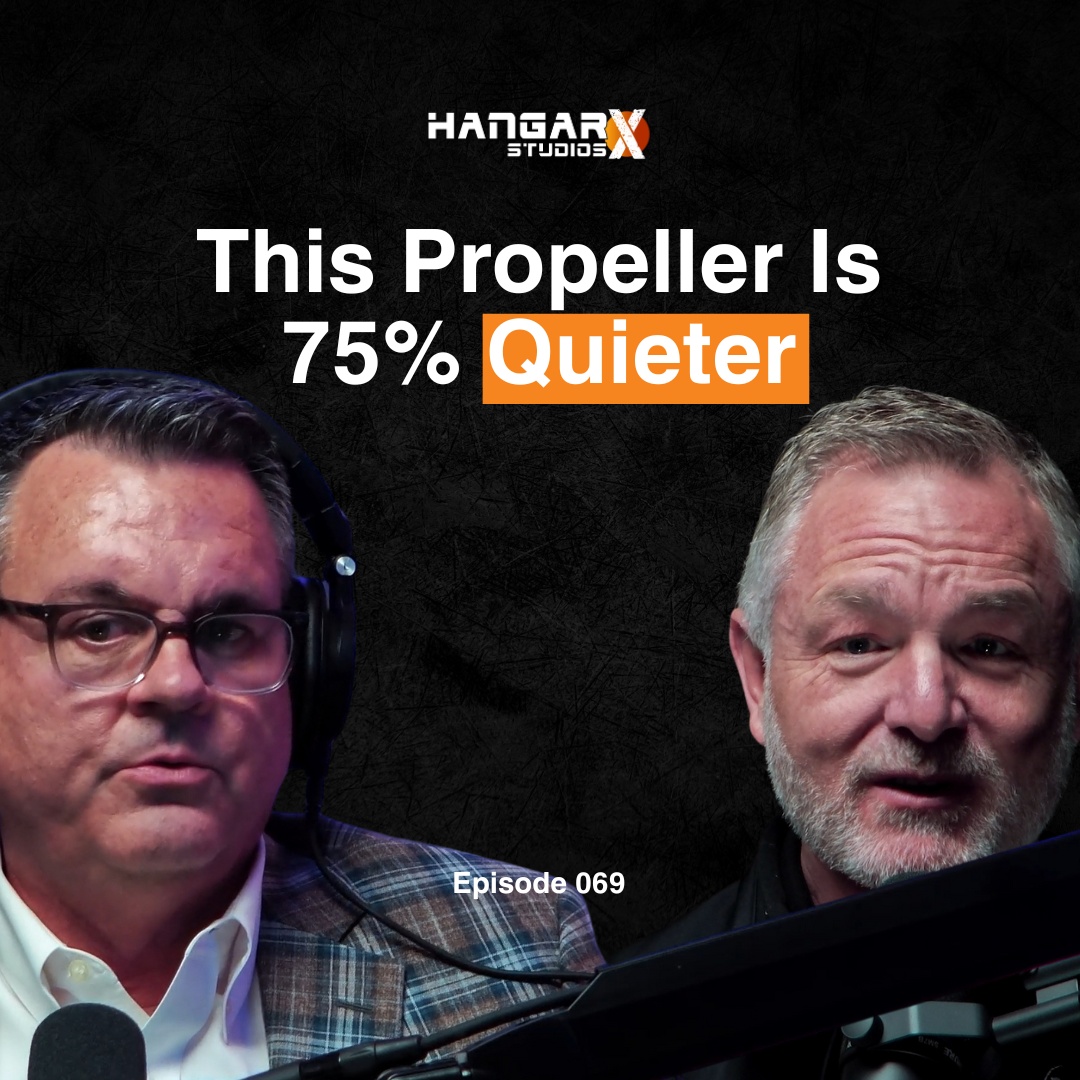
[00:00:00] Tony Bacarella: Knocking the cabin noise down by 75% for somebody and giving them 10%, 15% more range is going to be really significant.
Yeah, it's a big deal. So every pilot I talk to is excited about this as a development. But I still say I'm going to come back to the fact that I really believe over the next 10 to 15 years the hockey stick is going to be advanced air mobility.
Welcome to Hangar X Studios where former fighter pilot and host John Ramstead takes us on a journey across aerospace as it enters an historic period of innovation and transformation.
Our guests include aviation experts, pilots, financiers, military leaders and innovators of all types.
Buckle up for another episode of Hangar X.
[00:00:52] John Ramstead: Today's episode is brought to you by our platinum sponsor, XTI Aerospace. They are powering the the vertical economy, building a long range VTOL. And you can find
[email protected] now please remember to like, comment and share on this channel and enjoy today's podcast.
Hey, welcome to Hangar X and we are the voice of the vertical economy and the innovation that's happening in aerospace right now, especially around vertical mobility, powered lift and everything. Drones.
And we're going to be talking about the missing link, I believe that's going to help grow this entire sector meaningfully, especially adoption in our urban corridors and other special use cases. So before we do that though, please take a moment and subscribe and like to this channel so you get notified on all the content that we're coming out with weekly. So think about this. From drones to EVTOLs to high powered long range VTOLs, they all have to move air and the air that they're able to move is what really determines how far they can go, how fast they can go and also how quiet they are. What determines all of that is the propellers and the propeller systems. And here's something we're all probably painfully aware of. We've been aerospace there's really been no meaningful breakthroughs in propeller technology for decades and decades except until recently. And that's why we have Tony Baccarelli on from Athuli. And Tony, first of all, welcome to the the the podcast.
[00:02:29] Tony Bacarella: Thank you, John.
[00:02:30] John Ramstead: And and folks at Thule has done something remarkable in some breakthrough and propeller technology we're going to be talking about that everyone here is going to want to care about. So but before we do that, Tony, everybody gets an intro. So let me give you an intro so the folks out there know who you are because there are some really interesting aspects what we're going to be talking about today.
So today's guest, you read a Thule arrow and you are redefining propeller design. And we got introduced to you by one of our strategic partners. So this is exciting to talk about this patented technology.
It's quieter, it's more efficient, and it's tailor made for every mission. And Tony was telling me about some very unique missions they've designed for you guys are going to love to hear about.
But we're talking about propellers that reduce noise by up to 75% while increasing efficiency. What, 15%?
[00:03:23] Tony Bacarella: Yeah, up to 15%.
[00:03:24] John Ramstead: Up to 15%. So this is unlocking whole new use cases for urban air mobility defense beyond.
And it's not just an engineering story. This is an innovation at the propeller level.
Can completely accelerate adoption of the next gen of aircraft. But I do want to start with this.
The propellers, whether it's a drone from a DJI that might be going away to a giant VTOL and all the airplanes I've flown the last 30 years, it's not the sexiest part of the airplane.
So what is it about propellers that we should all be taking notice about now with the advancements you guys are making?
[00:04:01] Tony Bacarella: Well, the propeller, a lot of times is an afterthought, and it's boxed in by a lot of the other parameters of a vehicle.
A lot of times they're catalog picked even. Right. Some companies do go to the effort to custom design them to their platforms. But the reality is, in order to get the most out of a propeller, it has to be completely tailored to your motor, your airframe, all the different parameters of the aircraft.
We do that, but in addition to that, we bring in new technology to the propeller. Propellers are boring from the perspective of there's a thing spinning on there. And everybody can focus on new battery technologies and new motors and hybrid engines and things along those engines, those lines. But the propeller is actually one of the few places that you can impact a vehicle nearly as much as we can impact a vehicle.
[00:04:49] John Ramstead: What was kind of the aha moment, that breakthrough? And you said, you know what? We can build a company around this idea. And that became a Thule.
[00:04:56] Tony Bacarella: It's interesting. The technology was developed by two PhDs, one out of the Air Force Academy and one out of Baylor. And the technology was implemented through an AppWorks SDTR program to go validate that technology.
[00:05:09] John Ramstead: And what's SDTR?
Special defense. Yeah, it was a program by AffWorks and they funded this.
[00:05:17] Tony Bacarella: Yeah, Science, Technology.
[00:05:21] John Ramstead: Technology readiness.
[00:05:22] Tony Bacarella: Yes, technology.
[00:05:24] John Ramstead: The audience will correct us if we're.
[00:05:25] Tony Bacarella: Wrong by the way, but there you go.
So this was to go essentially take a platform that was being used by the military and ensure that it was quiet enough to be utilized in the infield. And so through that two year effort we were able to go validate the technology, improve it. And in that effort we realized the amount of benefit that we were going to bring to the platforms and what use cases it could go into, which is as broad as the aviation industry is with propellers.
[00:05:52] John Ramstead: Yeah, that's interesting. Now the technology you've patented trademark is called double brake. Could you describe a little bit about just, you know, people are used to the propeller on their like the Cirrus. I got this really fancy Scimitar design.
Right. And you know, there's been, you know, there's been some advancements, but this is a leap forward. Kind of like going from helicopters to this whole vtol.
[00:06:15] Tony Bacarella: Right. When you think about Scimitar is a good example. And they're trying to sweep the wings so that essentially you're getting a longer repeller. That is a lot like a. I like to equate things to more like a wingtip. You know, you would fold the tip up so that you can get some more efficiency out of it and you get a few percent efficiency out of a wingtip. This does something similar. We, instead of folding the tip of the blade up, what we do is we actually deload the tip of the propeller and we do that by rotating it so that it's in plane. And what that does is it says, okay, we're not providing any lift at the tip of the propeller. Completely counterintuitive. Aerospace engineers usually.
And this is because this is where you normally get the most lift out of a propeller.
And is it at the tip? At the tip? That's correct. Because if you think about it, it's at the end of the circle and so it's running. When you spin it, it's moving the fastest. It's the easiest place to get lift.
[00:07:10] John Ramstead: That outer third, what percentage in a normal propeller is where that thrust is coming from?
[00:07:15] Tony Bacarella: Say that one more time.
[00:07:16] John Ramstead: You know, a normal propeller, that outer third. When I'm at full rpm, what, what percentage thrust is from that outside area?
[00:07:22] Tony Bacarella: That's a good question. I mean the curve is very.
The majority of it is in that last third.
[00:07:27] John Ramstead: Okay.
[00:07:28] Tony Bacarella: Like if you were going to go create a really wide propeller on the inner third, you're going to get a whole lot. You're going to get less than 20% of your thrust in that spot. You can adjust it and do some interesting things down there, but what we do is we actually deload the tip and then we have an AIML enabled tool set that we've developed over the past couple years that enables us to go utilize hybridized airfoils and cord variations and pitch variations to essentially redistribute that thrust along the rest of the propeller, just like you were talking about.
And so it has some interesting effects. Not only do we eliminate the vortex coming off the tip because we've deloaded the tip, which is where the primary noise component comes from, but additionally, we can shift our noise profile, shift the tonality and shape the air flow coming off of the propeller as well. So if you've got impingement on a part of your aircraft that's causing vibrations and noise as well, we can actually shape noise around that sometimes as well. So it gives us a lot of tools to deal with noise, not just at the propeller, but also at the airframe level and to also increase the efficiency.
[00:08:36] John Ramstead: So I can understand if I create a shape so what the twist changes, what is changing and where am I picking up the thrust if I'm taking it away from the area that traditionally has been providing the most.
[00:08:51] Tony Bacarella: So you're just.
We had again, the CIML enabled tool, essentially we look at. Because it's cloud processed and it's highly parallel, we can run 100 propeller simulations all at once in parallel. Right. So we can do this really rapidly in days instead of months or weeks.
And what we do is we say, okay, depending on what the goals of the design are, we can make that flattened area be more or less the more that it is, meaning that the deloaded tip, the more, the longer that deloaded tip is, the quieter the propeller tends to be.
But that means you have to redistribute that thrust along the inside more too. So it's a, it's a optimization game that our tool does to essentially optimize pitch, airfoil and cord width and shape to enable the redistribution along the rest of the cord. So somebody may have a large obstruction in the center, and so they can't really deal with any airflow there. So we may have to even move out from the middle and move it in as well, and then only optimize to, say, 50% of the cord length.
[00:09:58] John Ramstead: So what I'm hearing in there is based on each use case and the platform that it's on, and maybe some of the either stators or some of the fixed things that might be around that propeller, you can actually then Do a custom design to say this is what's going to be the lowest noise, highest efficiency for that specific application.
So you do custom work like that also?
[00:10:20] Tony Bacarella: Yeah, the majority of our work is custom work. Right now we tailor propellers specific to platforms that need highly optimized noise and efficiency. Yes.
[00:10:29] John Ramstead: Okay, is this one off or is this sometimes mass production? Like we've, we solved the problem, but now you need a thousand of these or.
[00:10:35] Tony Bacarella: Yeah, it's. It's the gamut. It's a gamut. Yeah.
[00:10:37] John Ramstead: That's interesting. Now I know what you know, we've had a number of people on talking about infrastructure and urban air mobility and just the sensitivity to noise, especially when these, you know, when you know, the jobies and the archers and you know, all these air taxis are flying in and out of places, nobody's gonna hear like a super loud drone coming in and out all the time. So I'm guessing, have you got any feedback from the industry or any manufacturers like that about, hey, here's kind of the noise problem that we're trying to solve? Because I really think this is going to be key to communities.
We might want to put in a vertiport, but the community is still going.
[00:11:17] Tony Bacarella: To have to say, yes, that's exactly right.
There's a lot going on in this space right now with the FAA to work on infrastructure requirements, municipality requirements.
But to your point, there are noise figures that are out there already. The majority of the advanced air mobility manufacturers out there that are driving this area using multiple discs on their aircraft to actually mitigate that noise. That's one of the reasons that they have so many discs on their aircraft. But with that said, they're going to specific requirements. You've got cabin noise and then you've also got air density. Right. So as you've got more and more of these vehicles coming into a space, it's more. It's not necessarily just about at a certain elevation, being a certain decibel level. It's also about how many of these aircraft are operating in the area and knocking down below that. Right. So it'll be interesting to see how this shapes as we go forward with not only advance their mobility, but drone delivery. Both of those are about to really explode into the marketplace. With the beyond visual line of sight rulings now out for comment.
You know, that's becoming imminent and that's going to really open up the marketplace in that space. And so as you've got more and more drone saturation in areas and you've got AAM working their Channels and pathways. It's going to be an interesting development. And reduced noise is just going to help to augment that whole market space.
[00:12:45] John Ramstead: So you said 15% more efficient, but when I'm looking at putting four or eight of these on from a drone to our larger size, what's the practical increase in range or payload? Have you guys seen any numbers on that?
[00:12:57] Tony Bacarella: Yeah. So it's a. It's an interesting. Yeah. So up. We actually have. We. Our tagline is up to 15% more efficient and up to 75% more quiet.
And it's a. It's a gamut of capability in there, depending on how optimized their current blade is or, you know, what. What they're trying to do. But what I'll say is that we can 15 more efficiency can translate into any of those parameters you just said. Right. So if you need more speed or if you need more range, a lot of times those two things will go together anyway, so you'll get the gain on both of them. But cargo, you want to do more carry.
It's. It's a three. Think of it as three axes, and you can work your way within that gamut. We can either give you more thrust for speed, or we can give you more disc load for carry. There's a lot of variability there.
[00:13:44] John Ramstead: Would it be fair to say if I didn't care about noise because of my application?
Your custom process could say, hey, here's how we maximize efficiency and thrust. If I'm actually not. Would that. Is that something you might be able to do too?
[00:13:56] Tony Bacarella: Absolutely. Our tool is not just exclusive to our technology. It works on any propeller technology to include industrial apps and naval apps.
[00:14:07] John Ramstead: What would a naval app meaning?
[00:14:09] Tony Bacarella: Well, it's not an area we're focused right now. It's an area that we look as a growth path in our roadmap. But the propeller technology we have has the ability to also augment efficiency in the naval applications for propellers.
[00:14:25] John Ramstead: Oh, so underwater propellers, like on a big ship? Yes, actually, the science behind that. I used to be a submariner before I was a pilot. The science in those propellers is it's how like the big nuclear subs stay quiet because you can't cavitate, but you also need the thrust. But I digress.
Let me ask you a question. Where do you see your biggest market opportunities with this technology? I mean, commercial, military, small drones?
Something we haven't thought of yet.
[00:14:55] Tony Bacarella: So we're about to endeavor into a much larger investment into the manned space.
We've been primarily focused on the Drone space and are going to continue to maintain that. But next stack in our strategic roadmap is to go into the manned space, and we're beginning that later this year.
Advanced air mobility, we believe, is the hockey stick for the industry in the manned space.
[00:15:20] John Ramstead: So from large UAS to manned EV tools and things like that.
[00:15:23] Tony Bacarella: Exactly, exactly. And, and we're driving hard into that space right now, working partnerships and, and development cycles.
[00:15:32] John Ramstead: So anything surprising yet? Any new opportunities? Like, hey, that's something, you know, one, two years down the road that we.
[00:15:39] Tony Bacarella: Want to dominate that, you know, it's interesting. Advanced air mobility is definitely in that space.
There are a lot of fixed.
There's already a big market space that's installed. Right. When you think about general aviation LSAs, there's a lot of aircraft, light sport aircraft. Yeah, sorry, light sports aircraft and general aviation.
And so, you know, driving into those markets as well, if you think about a general aviation aircraft, knocking the cabin noise down by 75% for somebody and giving them 10%, 15% more range is going to be really significant deal. Yeah, it's a big deal. So when every pilot I talk to is excited about this as a development, but I still say I'm going to come back to the fact that I really believe over the next 10 to 15 years the hockey stick is going to be advanced air mobility.
[00:16:31] John Ramstead: Now, let's just say, you know, DJI is a topic of discussion. Let's say we can't get any more parts or drones from China. Is that a place you can, you know, that you're thinking about stepping into? Because there's going to be a huge market for people who want to keep their, their equipment they already have flying.
[00:16:46] Tony Bacarella: Absolutely. I mean, you know, there's a.90% of the drones come from China right now.
I would say it's probably a higher percentage than that for all the other components that come in as well for the drone space, including propellers. And we're going to need to compensate for that. And Athule is preparing to do that.
[00:17:04] John Ramstead: Wow, that's interesting. Now, one of the things you told me about earlier is you can build, you can build and develop a custom propeller in days and you know, weeks, not months or years. So what is, how do you guys do that?
Because one of the, I think pillars of the vertical economy is advanced manufacturing. It's something else. In addition to AI, you guys have embraced.
[00:17:28] Tony Bacarella: Yeah, I mean, we, you know, it's not even rocket science nowadays. Right. We do additive manufacturing for static testing of propellers to get to close our Loop on our propeller design platform and computational fluid dynamic modeling ensure that that's all where we think it is and, and then we move into a manufacturing step. So that cycle that you're talking to, you know, it's hard to affect the, the volume manufacturing timelines. Those are, you know, similar. They all have to be too old, they all have to move out. Right.
But we are doing some things in that space as well where we think we can accelerate the production and the volume capacity for the marketplace.
But going back to your question, normally to get a new drone propeller, you're looking at least weeks to design it or typically months, depending on what the complexity of the design is.
Because of our cloud based AI ML based tool, we're able to design that in days depending on the complexity of the model. If you're trying to do steady or unsteady flows, et cetera, then you know, that might take longer to model it and close the loop on it, a week kind of time frame. But you know, that gives us the confidence to go say, hey, we can give you this amount of performance and then make decisions and do, and close the loop with these companies really quickly and say, here's what we've got. You can plug it into your own cfd, you can go take a look at these models and figure out if you want to tweak it at all. And then close that loop very, very quickly.
[00:18:52] John Ramstead: And then how do you turn it into a physical propeller?
[00:18:55] Tony Bacarella: We build prototypes internally and that way we can go do static tests really quickly. We do additive manufacturing and carbon fiber layup for our prototypes and then more standardized carbon fiber builds for production.
[00:19:14] John Ramstead: Wow, fantastic. Now I would love to ask you. Well, you know, I was going to ask you about your most unique use case. I asked you that before we got started.
And it's a little, it's actually not a little classified. It is classified, but high level. What was that project?
[00:19:30] Tony Bacarella: So the.
It's military applications. You know, typically we're dealing with platforms that are taking off and landing and some things don't need to take off and land. They're already flying and they're getting launched.
Those applications tend to come with some pretty specific and demanding requirements that I can't really talk about. Sorry. But you know, those are, they've been interesting. You know how it is when you're working, especially for the military too.
[00:19:54] John Ramstead: If I can take a platform that's airborne and make it quieter or even 75% quieter, it allows, you know, in the, in the ISR mission, which I've been involved in back when I was active duty, you know, intelligence, surveillance, reconnaissance, you know, the closer I can get without being detected both visually, audio, heat signature, all of that allows different sensors and different either kinetic or surveillance capabilities. So love that you're doing that because you know what you're doing. You're helping the warfighter out there deliver, you know, be more survivable and be more lethal. So I'm a big fan of all those.
[00:20:28] Tony Bacarella: Yes.
[00:20:29] John Ramstead: But now bringing it back here to the States, you are getting more involved in AAM and you're doing some work with it's Delta Black Aerospace with their Raider 330 and what can. I don't know how much you can talk about what you're doing there, but I'd love you to share what you can.
[00:20:43] Tony Bacarella: I encourage people to look that platform up. It's not actually in the AAM space, it's more on the military logistics side.
And it's a super interesting platform that has a half wing channel that has all of the flight dynamics of VTOL and has to go through transition and long range flight.
And so as a, you know, medium sized blade that has all these flight dynamics, the modeling and intense design that goes into that is, you know, it's been a lot of fun and super collaborative with Delta Black. We've enjoyed that relationship.
[00:21:20] John Ramstead: And what's the benefit in addition to the noise reduction for them?
[00:21:25] Tony Bacarella: Efficiency. Yeah, efficiency. And efficiency is the reality is unless you're in the urban air mobility area or you have a specific tactical implementation, the majority of people care about efficiency first and foremost. Before they care about noise, they care about getting more range or carrying more weight. Those are more important to them than it is about the noise. Initially. Noise comes into play when you're in urban environments. And so when we start looking at urban air delivery and AAM and uam, that's where it's going to come into play a whole lot more and then specific tactical implementations.
[00:22:01] John Ramstead: So question your blade versus a traditional rotor in a, let's say a vertical, you know, positioning.
Is it the same downwash, outwash as a regular rotor or is that also a different profile? Have you tested that?
[00:22:18] Tony Bacarella: Yeah. So it's super interesting and you can see all this in the computational fluid dynamics and then smoke test modeling in real world.
It's almost a more collimated. Think about the way a ducted fan works where you've got a collimated output. It's a more, it's a more constrained flow that comes out.
And so it has some interesting Effects as well when you think about blade to blade feed in as well.
So when you've got multiple blades right next to each other, you have less prop feed from one prop to the other because it is more of a. A channeled output.
[00:22:51] John Ramstead: Right. Which is.
It'd be interesting to see that modeled and what that actually means to the aerodynamics because I know they did the testing on this. We actually found that in ground effect because it was so channeled, it was bouncing off and coming back up and hitting the fuselage from both sides.
[00:23:07] Tony Bacarella: Interesting.
[00:23:08] John Ramstead: It actually was, I think equivalent of Almost an extra 800 pounds of thrust just from what that aerodynamic effect and ground effect was doing.
[00:23:18] Tony Bacarella: Interesting.
[00:23:18] John Ramstead: I don't know if that was the exact number, but it was meaningful.
So that was interesting. So question for you, kind of a two parted question, maybe kind of end with this is, you know, what is your kind of your vision of propeller technology? And like let's say it's. We did something like this in five years from now as you keep making advancements and this gets adopted, you know, what, what does that do with the whole aerospace industry and everything that's happening right now?
[00:23:42] Tony Bacarella: I think it's going to enable it more to a large degree to go address a lot of the urban environments that we've talked about already.
What I see from an Ethule perspective is we have other items that are in innovation stage right now that'll start to be worked in, that are outside of our double break that will add capability to the propellers as well. So there are things that have been worked in industry, wink tip treatments and different aerofoils and. And I just see that the envelope of performance is going to open up even more from where we currently see it.
And it's not through rocket science implementations really. It's from taking the IP that we have and implementing it in addition to that.
[00:24:27] John Ramstead: Yeah, love that. So Tony, where do people find out more either about you or Ethule or what's the website? How do people get more information, do more research on this?
[00:24:37] Tony Bacarella: Yeah, absolutely. Appreciate the offer there. It's a www.athule which is a t h u l e dot com.
You can hit that. There's a link there to request information, etc. It's a great way.
[00:24:51] John Ramstead: And there's also some great videos on there kind of showing some of the things going on. So I want to land the plane on this. So with this advancement, both efficiency and noise and the customization, what impact is this, I guess advancement in technology going to have on other segments of Aerospace. Where do you see some of those direct links of what this enables?
[00:25:17] Tony Bacarella: That's an interesting question. So, you know, we're going to go directly address, like I said, Jayville General Aviation. We're going to hit the drone market pretty aggressively. Where I see the interesting parts coming down the road is when we start looking at more regionalized hybrid electric aircraft as well and essentially moving into that turboprop space where you can actually get very long ranges out of these hybrid vehicles and then us enabling that with an additional 10 to 15% of performance on that. I think that is going to be a really interesting growth segment as we move forward. And I think the aircraft behind us is one of the ones that is going to show that very, very interesting innovation.
[00:25:57] John Ramstead: Yeah, interesting. So love the work you're doing. You know, is she getting breakthroughs or case studies or, you know, when you can talk about that military case study, if that ever gets to the point where you can talk about it openly, because I believe I'm very familiar with that application.
But love to. Any breakthroughs, wins, commercialization that happens. Up come back. Let's keep everybody up to date because, you know, as everything advances. Right, right.
Power systems, advanced air traffic control, how we're using AI, advanced manufacturing, propulsion systems, there's so many elements that are going to allow this whole segment to just have absolute breakthroughs. So thanks for coming on, Tony. It's been great having a conversation.
[00:26:39] Tony Bacarella: I appreciate the opportunity and look forward to engaging with you in the future.
[00:26:42] John Ramstead: Yes, me too.