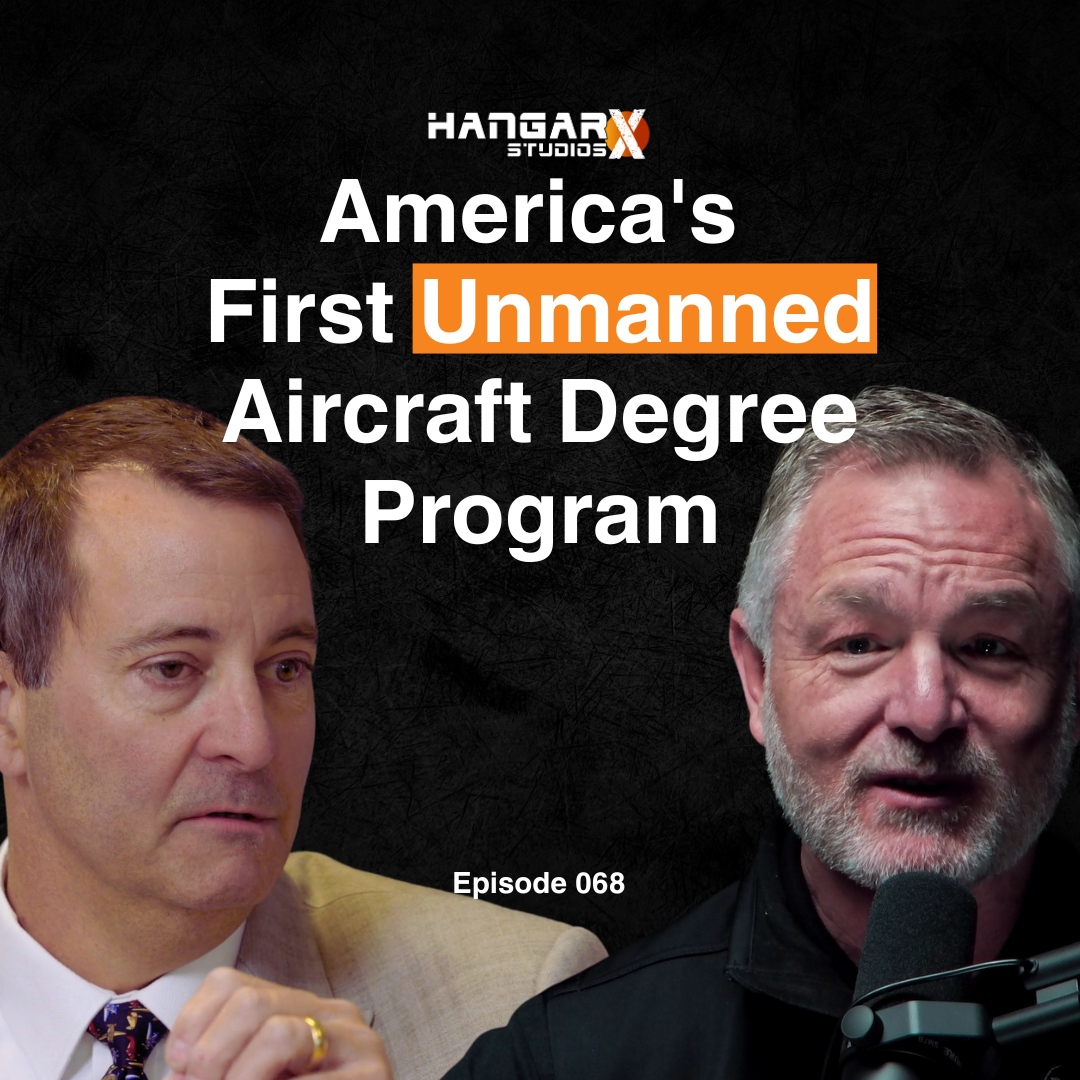
[00:00:00] Dana Sande: Most people don't know that the University of North Dakota has and had the first unmanned aircraft degree pilot degree program in the country. So back in 2008, Senator Dorgan got us an appropriation. We became the center of excellence for unmanned pilot training. Multiple different years since then, it's been the fastest growing degree program on campus.
[00:00:24] Intro: Welcome to Hangar X Studios where former fighter pilot and host John Ramstead takes us on a journey across aerospace as it enters an historic period of innovation and transformation.
Our guests include aviation experts, pilots, financiers, military leaders and innovators of all types.
Buckle up for another episode of Hangar X.
[00:00:54] John Ramstead: Today's episode is brought to you by our platinum sponsor, XTI Aerospace. They are powering the vertical economy, building a long range VTOL. And you can find
[email protected] now please remember to like, comment and share on this channel and enjoy today's podcast.
Welcome back to HangerX and we are live today at the Hive in Grand Forks, North Dakota. And I have Dana Sandy on today and this is going to be a very interesting conversation for everybody.
We came up here a few months ago and we had a meeting at the University of North Dakota. And our friend Johnny Ryan here, who runs the Hive, says, hey, you need to meet with the Aerospace Foundation. And I wasn't exactly sure what the meeting was about until I started doing some research and then really understand that the UND Aerospace foundation had incredible capabilities. And then you and your team, you were so generous with your time, showed us what that was about. And I know that a company we work with, XTI Aircraft, is going to be tapping into the capabilities there significantly from subscale prototyping, rapid prototyping, flight testing, training. Well, let me let you certainly hope so. Yeah, let me let you tell the story because I think a lot of people are familiar with UND's aerospace program, pilot training, you know, all the air.
[00:02:16] Dana Sande: Traffic control training, air traffic control, engineering sciences, you name it.
Right. The University of North Dakota basically trains anything from the ground up from flying airplanes to designing airplanes to atmospheric sciences and air traffic control and managing traffic management, certainly, and airport management, you name it. So the University of North Dakota, when it comes to aviation, they do it and they have the expertise and the professors that have been working in industry and now are in teaching the young people how to work through all of the avenues in aviation.
Regardless of what their career goals would be, the University of North Dakota has a pathway for them. Our foundation was designed to help the University operate at the speed of business. There are lots of governments and organizations, companies in the United States and throughout the world that want to tap into the expertise of the University of North Dakota and the aviation program.
Unfortunately, the University of North Dakota being a state run organization at the time, they would have to go through the state board of Higher Education to get any sort of a contract signed. So that's why our foundation was created. That sounds like a slow, frustratingly laborious.
[00:03:35] John Ramstead: Process to try to tap into that, certainly that pool of intellectual capital. Is that right?
[00:03:39] Dana Sande: Yes. And our foundation was started around 1985.
The concept was so that John Odegaard and the principals within the Odegaard school could go and get international training opportunities and take advantage of the shortage of pilots internationally at the time.
So Tom Clifford, who was the president of the university at the time, he and John Odegaard worked together to sign an operational agreement that allows our foundation to essentially sell the excess capacity of the Odegaard school. So by doing that, they've already, we've already got the functional agreements in place that allow me to go out and sell training, whether it's air traffic control training, pilot training, curriculum development.
I can sell it to a government or an organization like XTI and then I can tackle it.
[00:04:33] John Ramstead: You did that for Cirrus?
[00:04:34] Dana Sande: For Cirrus certainly is a great example.
[00:04:36] John Ramstead: I think everybody would be familiar with.
[00:04:37] Dana Sande: Yeah, we, we did the factory training for Cirrus for 20 years. We, we actually manage Cessna's elearning website and have built many of Cessna's training courses, their caravan icing course, and other courses that are mandated by the FAA for Cirrus or Cessna pilots to fly or to, to take in order to maintain their certification in the caravans.
[00:04:59] John Ramstead: Right.
[00:05:00] Dana Sande: So, so we do, we've done lots of those things. We also have, because of the, the operational agreements, we can sign pilot training agreements with airlines in Asia, Europe, you name it. We can sign air traffic control training agreements with the government of Norway or others.
So because of that, ultimately the purpose for our foundation and to help the university operate at the speed of business is so that we can generate revenue. So our foundation generates revenue and then we take, we take our proceeds and we reinvest into the university and into the aviation program. So we own half of the fleet of airplanes at the airport.
[00:05:47] John Ramstead: How many is that?
[00:05:48] Dana Sande: We own about 60.
The total fleet at Grand Forks Airport is about 140. We own close to 65 airplanes, if I recall at last count. And we allow the university to use them at cost. All they do is pay us whatever our cost is to straight pass through.
[00:06:06] John Ramstead: It's a straight pass through flight training.
[00:06:08] Dana Sande: Again, affordable as possible. Yes, that's the purpose is to keep the cost of flight training or air traffic control training, any of the training programs within the Odegaard School to keep the cost of training down for our traditional US undergrad students. So we underwrite a significant portion of the cost of training for the traditional US students here in Grad Force.
[00:06:29] John Ramstead: Yeah. And now one of the things and we went and toured it last time that the. The foundation has developed is a place called Gorman Field. Because there's a very also unique, in addition to aerospace flying fixed wing and helicopters, there's a, also a pretty unique kind of VTOL and UAS community business infrastructure here. So tell us a little bit about Gorman Field and why everybody out here should probably be interested in knowing what it is.
[00:06:56] Dana Sande: Certainly most people don't know that the University of North Dakota has had, has and had the first unmanned aircraft degree pilot degree program in the country. So a four year degree program.
[00:07:08] John Ramstead: I actually didn't even know that was a degree.
[00:07:10] Dana Sande: That's interesting. Yeah, we have a four year degree program. We have two different tracks, commercial one where you have to get your commercial certificate. That'll allow you to ultimately fly UAS in the national airspace system and get paid. Because the only way to get paid flying in the NASA is to have your commercial certificate. We also have a small track for people that want to get into flying smaller drones. They don't have to take all the flying classes.
Keeps the cost of training down.
So back in 2008, Senator Dorgan got us an appropriation. We became the center of excellence for unmanned pilot training.
Ultimately grew the degree program at multiple different years. Since then it's been the fastest growing degree program on campus at the University of Dakota. Yep.
[00:07:56] John Ramstead: You know how many graduates, I don't.
[00:07:58] Dana Sande: Know how many, how many we have, but we have about, we average about 200 undergrads at any one. Oh, wow.
[00:08:04] John Ramstead: Okay.
[00:08:05] Dana Sande: So. So we're producing lots of highly skilled, highly technical unmanned aircraft professionals that are looking for jobs actively.
But let me ask you a question.
[00:08:16] John Ramstead: Because my sense is the job market and the way drones have exploded is if I take that degree and graduate, I would think that there's going to be. There's a lot of demand for those jobs. Is that fair?
[00:08:28] Dana Sande: Both for the.
[00:08:29] John Ramstead: They're not sitting around unemployed.
[00:08:30] Dana Sande: Both for the commercial side and the smaller side, there are lots of opportunities available.
Most people don't know this, but there are more. For example, there are more UND grads flying predators than Any other outside of the US Military, there are more UND grads flying preds worldwide than from any.
[00:08:54] John Ramstead: I met three of them at coffee this morning. They were back here from some recurrent training from places all over the country.
[00:08:58] Dana Sande: There you go. That's right.
[00:08:59] John Ramstead: And all they were doing is flying MQ9s.
[00:09:02] Dana Sande: That's right. And all of that training is happening here in ground force, which is amazing.
Ultimately, the, the flight program, our, our UAS flight program needed a place for the students to get their practical flying done.
They were flying out in a farm field with a porta potty and it just, it's not who we are. Our organization, the University of North Dakota and our aerospace foundation, we like to provide the best facilities that you could have for the students because it's important for students to, to work, to learn in an environment as nice as where they'll ultimately work one day. And so our foundation, we, we did some fundraising.
A UND grad, a commercial airline grad, gave us a little over a million dollars to help us find a, find a location and build a facility for our unmanned aircraft training.
Ultimately, we ended up about 10 miles west of Grand Forks. We purchased 33 acres and have built a 12,000 square foot facility, which is about 9,000 square feet of hangar and workspace and 3,000 square feet of office space and multiple different control centers so that you can actually fly in the university's undergraduate program. They're fly the Scan Eagle. We have the control center so that they can fly the Scan Eagle from inside the facility when they launch outside. So it's a beautiful facility. And we're actually already looking at buying, doubling the size of the land and building a couple more buildings because the demand is so high.
[00:10:43] John Ramstead: Oh really? What are the capabilities of that other than, you know, the infrastructure and you know, the vertiport's not the right term. Right. Because it's smaller than a helipad for drones.
[00:10:56] Dana Sande: Right. Well, we're actively looking to put in a Runway to help with some of the, we assume some of the drones that aren't.
We would assume everybody would want vtol. Right. That's where the industry is going. And so we built a concrete pad and have some other level areas where we can launch and recover vtol.
Of course, the minute we got done and we're ready to go, the first people that walked in the door said we need a 1500 foot Runway three feet wide. And so, and, and so what was that?
[00:11:31] John Ramstead: What kind of drone is that?
[00:11:33] Dana Sande: Pretty good size. Pretty good sized drone. Right. And, but not so we have other, there are other places around town where you, you could operate that, that aircraft and they're all good.
It's just we think we have the right mix of, we've got the right facility, it's easy at a Runway.
[00:11:52] John Ramstead: Then you can do all that at the same place.
[00:11:54] Dana Sande: Right, right. You can, we have a place where you can, where you can do some research if you want to. If you need to make some modifications to your aircraft, you simply bring it inside. It is four seasons all weather. So there are certain companies that are looking for, for winter testing those sorts of things.
[00:12:10] John Ramstead: So we, you guys get much winter up here and we get a little bit of winter.
[00:12:14] Dana Sande: Yeah. We don't get that much snow though. It's just really cold and windy. Yeah, but so we went into it with our eyes open. We knew that we didn't know what we were going to need.
[00:12:24] John Ramstead: Yeah.
[00:12:24] Dana Sande: And so the plan was always let's get something set up, see what people are looking for. It'll meet the needs for the university right away. But then as commercial customers come, we have, we have, we have space and are readily available to expand should we need to.
[00:12:38] John Ramstead: Well, yeah, I know XTI is working with a team up here to do rapid prototyping and all that flying is going to be done out at Gorman Field as they keep iterating to get better and better data and improve their prototypes for their engineering team.
[00:12:54] Dana Sande: Yeah, it's going to be a great partnership.
[00:12:56] John Ramstead: That team's going to be up here quite a bit.
[00:12:57] Dana Sande: We certainly hope so.
[00:12:58] John Ramstead: Yeah. Well, as we wrap up, what are some of the things that the Aerospace foundation is focused on over the next year?
[00:13:07] Dana Sande: Well, in the UAS side, we're doing lots of support there. As most people know, grand sky has a lot of really fun things going on. With General Atomics in north of Grumman. With the Test Resource Management center coming to grand sky, there are lots of opportunities for testing training, providing personnel partnerships with Gorman Field for beyond visual line.
[00:13:32] John Ramstead: Of sight training, also partnerships with the military. They've been very cooperative. Colonel Monroe's coming over tomorrow afternoon.
[00:13:38] Dana Sande: That's great. Yes, certainly the Air Force base. We've had lots of discussions about potentially launching from Gorman Field and sending drones toward the Air Force base so that they can test their drone recognition capabilities, those sorts of things.
[00:13:52] John Ramstead: So you're going to be any shoot down.
[00:13:54] Dana Sande: So we, I don't think we're going to shoot.
[00:13:57] John Ramstead: Okay, that'd be fun to film that.
[00:14:00] Dana Sande: No, we don't fire, we don't fire missiles Some of our grads do though.
[00:14:04] John Ramstead: You know, actually we interviewed a company. You know what their anti drone technology is? Microwave based.
[00:14:09] Dana Sande: Wow.
[00:14:09] John Ramstead: It just, it. It just. You could take a drone swarm and it fries the drone storm.
[00:14:14] Dana Sande: Okay.
[00:14:15] John Ramstead: I wonder if it really works. But that would be.
[00:14:17] Dana Sande: The technology is changing. Changing so fast it's hard to keep up with it.
[00:14:22] John Ramstead: Yeah. I won't say any of the specific locations, but we've seen some of these drone swarm attacks and having drone swarm defenses, I mean there's a lot of opportunities, you know, if you look almost like this way of, you know, like, especially in this ecosystem. We interviewed some companies. You're. They're developing, you know, the, the drone technology.
New applications, both military and commercial. But. But then there's also. There's always the other side of that coin when it comes to a military planner is, hey, how do I defend against that new capability?
[00:14:50] Dana Sande: And counter drone is all the counter drone.
[00:14:53] John Ramstead: So American entrepreneurs that have this infrastructure, access to capital, access to great people. So anyway, keep up the good work and Zane, I look forward to our next conversation.
Of course.