Episode Transcript
[00:00:00] John Ibele: Unfortunately, I would say a lot of our high volume manufacturing just immediately goes overseas without another thought. We've kind of undersold the advantages that you have in producing domestically. And I think that's starting to come around as people recognize the full benefits, not just from a national security perspective, but just keeping close to the consumer, taking full advantage of the skilled labor that we have in this country.
This can be done.
[00:00:28] Intro: Welcome to Hangar X Studios where former fighter pilot and host John Ramstead takes us on a journey across aerospace as it enters an historic period of innovation and transformation.
Our guests include aviation experts, pilots, financiers, military leaders and innovators of all types.
Buckle up for another episode of Hangar X.
[00:00:58] John Ramstead: Today's episode is brought to you by our platinum sponsor, XTI Aerospace. They are powering the vertical economy, building a long range VTOL. And you can find more at xtiaerospace.com now please remember to like, comment and share on this channel and enjoy today's podcast.
Welcome to hangerx Studios and we are live today at the Hive in Grand Forks, North Dakota. And we have John Ibalon from Metalark Aircraft Manufacturing.
[00:01:29] John Ibele: That's right.
[00:01:30] John Ramstead: So aircraft company. So John, first of all, welcome to the podcast.
[00:01:33] John Ibele: Thanks a bunch.
[00:01:34] John Ramstead: So it's pretty exciting. You know, we're up here in North Dakota and XTI Aircraft, who we do a lot of work with, just opened an office here to do our rapid prototyping.
We were just talking with some other people who were part of this that just the supply of drones, American made drones. What's happening in China, it's a big issue. What you guys are doing is you started a company to actually build drones, bespoke drones, custom. But you're also looking in the future to how do we possibly manufacture at scale? And it's really cool with your background at Seagate, which you were talking about and I had a background at emc, but you were in China. You saw them manufacturing what, millions of things a day. Right, Right. So you saw the capabilities over there.
But before we get into, I think some of those business issues that I'm fascinated about, tell us about metal arc. What was the idea behind it that brought some people, engineers and some different industries together to say let's build because you guys are pre revenue. You've had some investments with some of the funds that are available up here in North Dakota. Right. But what's the vision behind it?
[00:02:42] John Ibele: Right, sure. Well, Ned Tabet, my business partner and I had some initial conversations going back, oh, a year and a half now.
And he had been up here in the Grand Forks area for some time.
We met at Seagate Technology. And so we have a background in a very different kind of business and a very different kind of market. So people can ask how in the heck do you make a transition?
[00:03:03] John Ramstead: Yeah, how did you.
[00:03:04] John Ibele: From data storage and for us disk drive recording heads where serious volumes are a million widgets per day in Asia factories.
How does that translate and transfer into drones? So he's been spending his time here absorbing what's going on in this area and the ecosystem around unmanned aerial systems and approached me with the idea of setting up a company to build drones in the US and so yes we're focused on bespoke manufacturing and customization but really this is going to be a manufacturing company. We are going to manufacture drones.
And so there are assembly line or.
[00:03:46] John Ramstead: One off course to custom or kind of all the above eventually.
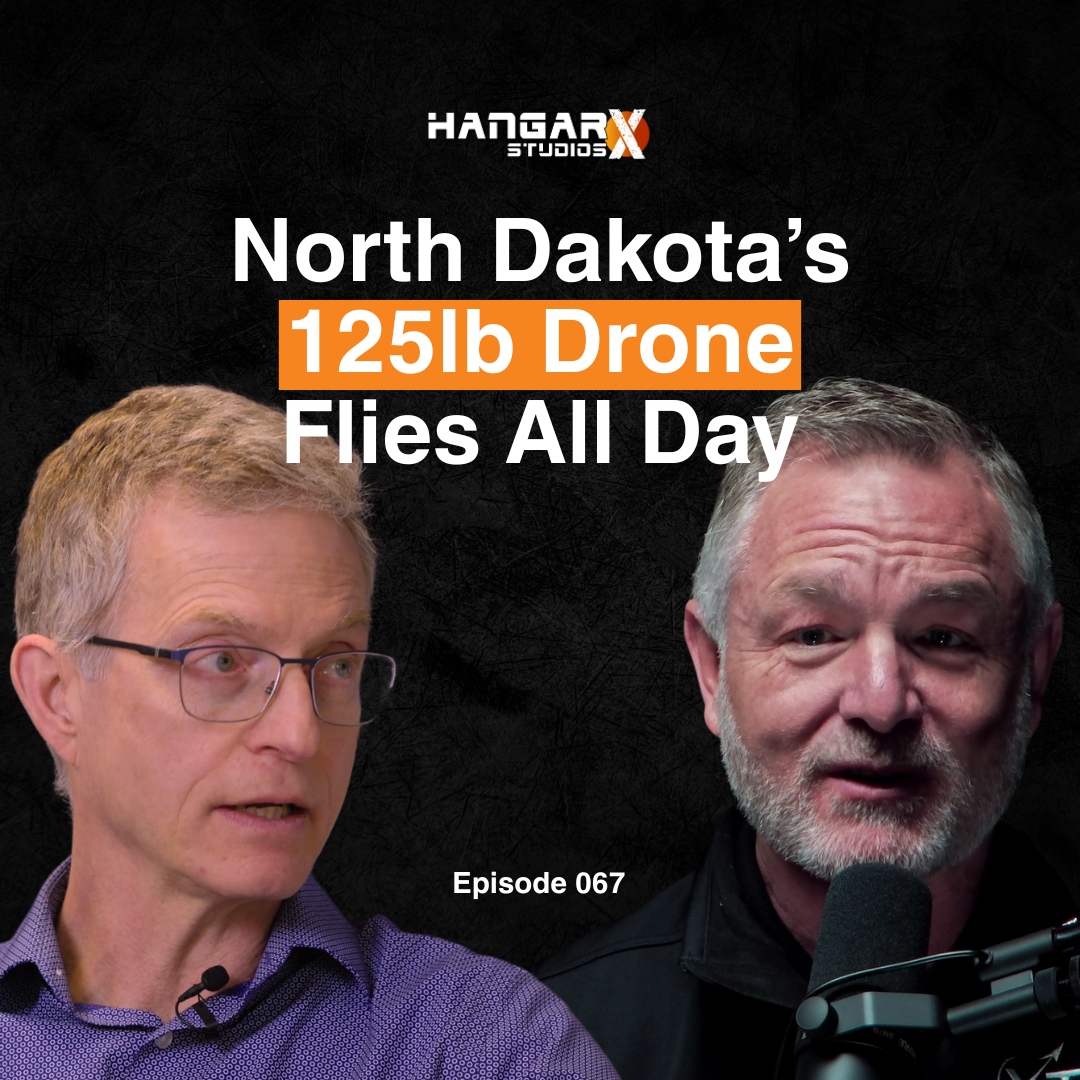
[00:03:50] John Ibele: So our Cornerstone product, the FH125 will be really taking advantage of the ability to serve the commercial market domestically with fixed wing VTOL aircraft, 16 foot wingspan, quad rotors to take off and land and a wing that you rest on once you're cruising at say 50 knots, 60 miles ish, kind of on a miles per hour, 400ft off the ground. And that is really focused in on rural infrastructure and data collection for perimeter management, wildlife management, precision agriculture, surveillance, fire and rescue.
That's the sort of thing that this new market can kind of serve and we'll be at the, at the forefront of that.
[00:04:36] John Ramstead: Yeah. And the drones you guys are building are really fascinating. The website, if anybody want it's macnd.com correct. If you would just want to see the prototype actually what you're. What you're putting out there right now. But how did you guys come up with that design as the first design that that those kind of capability specs.
[00:04:53] John Ibele: So that really takes advantage, full advantage in our perspective, takes full advantage of this new market and really is the optimal way of serving customers in that area.
This will be able to basically fly all day and stay up in the air at a reasonable speed, reasonable distance off the ground so that sensors can collect rich data sets and be able to transmit those to the customer. And so you asked.
[00:05:23] John Ramstead: I do have a question though. If I'm up all day. That is massive data.
[00:05:28] John Ibele: Yes, it is.
[00:05:29] John Ramstead: These are high fidelity sensors, cameras, lidar.
How do you get this like probably gigabytes, terabytes worth of data.
So then process that's probably got to be part of the solution set.
[00:05:41] John Ibele: Sure. So some of that can be assisted by the customer. Some of it can be just owned by the customer if they want to be able to do that. But part of that, we've got to also be able to serve the customer in terms of being able to provide the internals to allow them to do whatever edge compute they want to be able to do.
Because obviously you've got to have either a combination of edge compute right on the aircraft or data transmission rates that allow you to transmit that rich data set as you're flying to your ground control station. Are you tackling both of those customers? So we are working through how that will work. The first thing to do is get an aircraft in the air, but we're already starting think about how we help the customer manage those kinds of data sets. Yeah. And so you asked a question about volume, and it's a really good question because, you know, all sorts of choices in engineering are going to be driven by this volume question. And so what you do for a DJI drone or a consumer drone that you're selling, you know, hundreds of thousands in a given period of time, as opposed to tens or hundreds, that will drive a lot of manufacturing choices. Whether you're doing injection molding, whether you're doing carbon fiber composite, whether you're doing an aluminum machine part or not. These are all questions that are down in the details of the design.
[00:06:58] John Ramstead: But you've got that design also then affects manufacturing.
[00:07:01] John Ibele: You've got to have really a rich discussion between design and manufacturing about what the trade offs are. And we refer to that as DFM design for manufacturing. And there are best practices that are really at the core of what you do when you're designing for high volume. It's something that people do each and every day. Now, unfortunately, I would say a lot of our high volume manufacturing just immediately goes overseas without another thought. So that's the other thing that goes into this company is we have learned a lot about producing in high volume in the data storage industry.
And I think that there's a lot there that can be applied both in terms of business processes and how you optimize, both for volume, but also for customization in a volume environment where you can and not sacrifice quality. Do you pay a price premium when you're delivering domestically? Sure. Or producing domestically? There is a labor offset.
[00:08:00] John Ramstead: Is the premium just labor?
[00:08:02] John Ibele: The premium is primarily just labor because material costs are going to be material costs. Okay, you could have some premium associated with producing domestically, but capital cost is capital cost the world over. So the price of capital is what it is. And I think we kind of undersold the advantages that you have in producing domestically. And I think that's starting to come around as people recognize the full benefits, not just from a national security perspective, but just keeping close to the consumer, taking full advantage of the skilled labor that we have in this country.
This can be done. And to be honest, North Dakota is a great place to do that. Not just because of the focus on UAS and the drone market, but because of an educated workforce and the other political and other support that we've gotten in the region.
This is a great area to be now.
[00:08:57] John Ramstead: Do you. Yeah, I would agree with that. And with your experience in China, seeing very large scale manufacturing, you probably know exactly how drones would be manufactured there.
What does that, you know, what does that help you guys inform you with what you're building here? You said dfm, right? Designed for manufacturing. Right.
Because eventually, if the way things continue, we're going to need domestic source of drones because the demand is growing and the supply chain is.
[00:09:30] John Ibele: We have shaky will. Yep.
So some initial ideas. First of all, when you're doing prototyping, that's something that is still done in America a lot.
But when you're building one or two of something, there's an element of craft to it.
You're still figuring out manufacturing processes. Not all of those have been ironed down, ironed out, but fairly early on in that process.
Quite often we see transfer overseas, either to overseas engineering teams or the processes are figured out to some initial degree.
[00:10:04] John Ramstead: And then ask you a question, did that happen? Just. Did we just lose our ability to really manufacture? Or did what. When did it become. We're transferring over to China just became the default.
So.
[00:10:15] John Ibele: And it's, and it's not just China. I would clarify, there are companies.
[00:10:18] John Ramstead: How about overseas?
[00:10:19] John Ibele: Sure, sure. Broadly throughout Southeast Asia.
And that could be Malaysia, Indonesia, Thailand, all have capabilities and labor rates that are attractive. So sure, it was driven by cost. There's no doubt about that. And people looked at the cost of assembly and manufacturing and said, well, here's a low cost labor force that's reasonably educated and governments that we can work with. So I think that's how it started.
And then I think once a pattern gets set, people have a pattern that they can follow. They have a recipe that they can follow. And that's just, that's the easy path. So they hit the easy button and they go, yeah.
So it takes a little bit more work to maybe to reactivate some muscles that haven't been used for a While. But that's not that the muscles aren't there, that the capability isn't there. We know that.
[00:11:14] John Ramstead: Yeah. On with your background, you guys are trying to bring it back. So at Metalark, go ahead.
[00:11:20] John Ibele: Well, so I was going to say, so you start in the prototype phase. So you know, what are the things that we've handed off? A lot of it has to do with this design for manufacturing piece.
And so I have the experience of running large development teams, but these are not development teams that are focused on design of a product. This is not a product design team. This is a product process development team. And so a lot of people don't even understand in detail what a process engineer does, but they are really charged with developing, defining and optimizing a manufacturing process. And so what do you look at when you're optimizing a manufacturing process?
You're looking at performance, cost and quality and you need to deliver all three of those things.
So as you envision volume growing, you need to take a look at what kinds of volumes are you talking about? And then you have to take a look at, well, what are your biggest cost drivers? Is it scrap, you losing too many parts in the line? Is it labor? You need to take some of the labor out. Then you get into capital equipment and capital equipment development. Sometimes it can be fairly inexpensive tools that you can develop right within your company to be able to either improve any of those three legs or that three legged stool.
[00:12:36] John Ramstead: Yeah.
Wow. Fascinating. So as we wrap up over the next year, what are some of the big milestones that Meadowlock you guys are aiming to hit?
[00:12:46] John Ibele: Yeah, sure. Great. So we've got a multicopter in design. Right now we have our FH125 we code name Strix, which will be the stay up all day, collect rich data.
[00:12:57] John Ramstead: That's the one that's on the website with the wing.
[00:12:59] John Ibele: Absolutely.
[00:13:01] John Ramstead: What's the weight of that?
[00:13:02] John Ibele: So, well, we're actually on a diet right now. We've got our budget, but we're really targeting gross takeoff weight of 125 pounds. But that's easily going to be able to take enough gas to keep you up in the air all day and then whatever sensors you would want to put underneath, whether that's £30 or wherever it is, and you've got this mix between, well, okay, how much fuel am I going to carry?
[00:13:28] John Ramstead: And you can go beyond line of sight.
[00:13:31] John Ibele: Right. So that's, you know, that's, that's what we're focused on is line of sight. And along with the rest of the industry, you know, tackling this problem of collision avoidance, because you've got to be able to do that as well, so.
[00:13:41] John Ramstead: Right.
[00:13:42] John Ibele: But that's. That's the intent.
So those are. Those are really the two biggies.
[00:13:47] John Ramstead: Right.
[00:13:47] John Ibele: I would. I would look at. Obviously, a key milestone is get an initial strict up in the air, proof that it's capable of doing what we say it's going to be capable of doing.
[00:13:56] John Ramstead: And you're gonna fly that out of Gorman.
[00:13:58] John Ibele: That'll be an exciting day. We'll fly it right here.
[00:14:01] John Ramstead: Right here. Love it. Well, when you fly it, let us know.
[00:14:04] John Ibele: Yep.
[00:14:04] John Ramstead: Because we'd love to come film that and be part of that and watch this first milestone and just share it with everybody, because that's. That's exciting. We love to see entrepreneurs and companies succeed in this space.
[00:14:16] John Ibele: Yeah. Obviously, that's going to be. Be a very exciting day for us, and we'd be glad to have you there.
[00:14:20] John Ramstead: Okay. All right. Thanks, buddy.
[00:14:22] John Ibele: Hey, thanks so much.