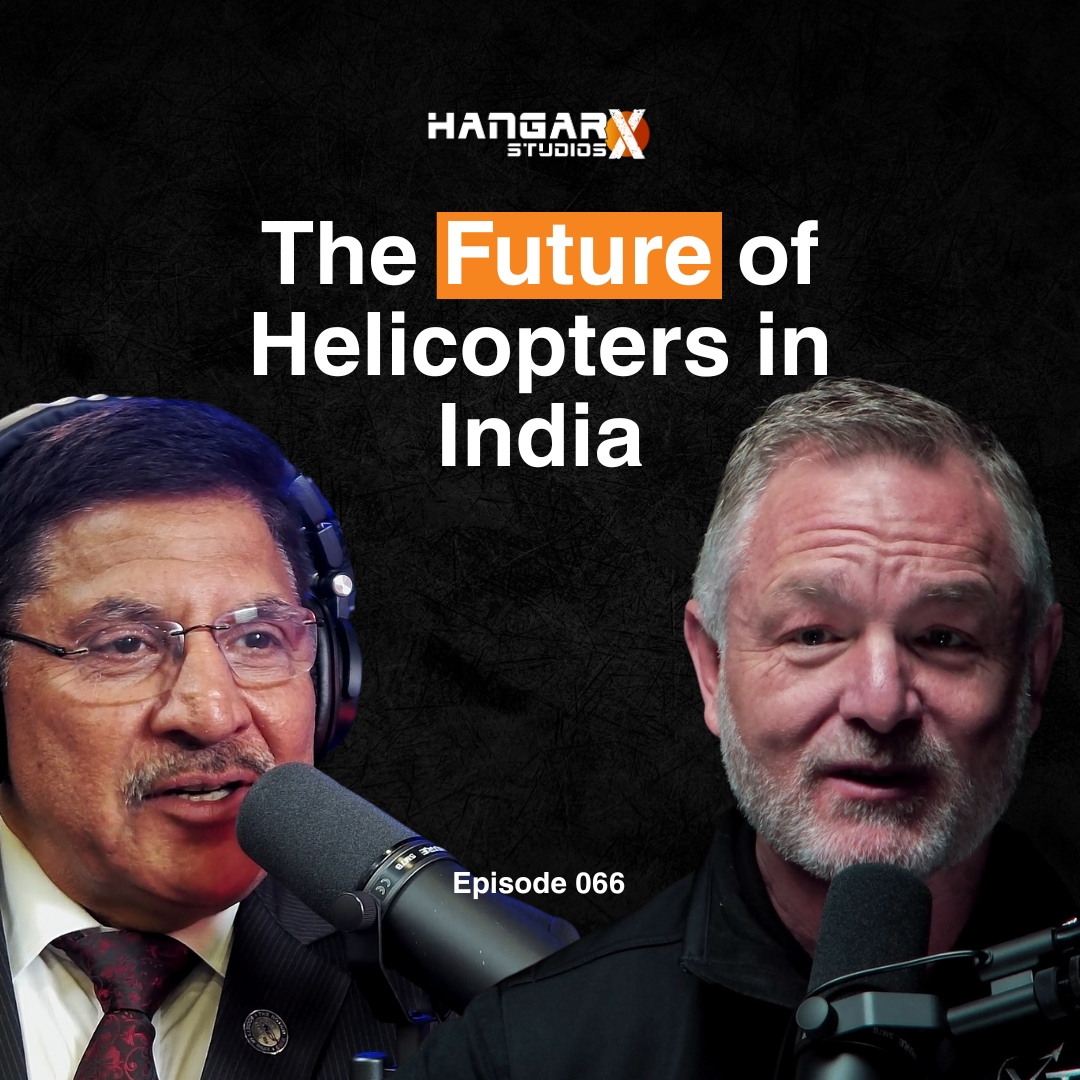
[00:00:03] Speaker A: With India, seventh largest country in the world, largest population, and if you take the strength of helicopters to the population, it's actually insignificant. Just about 270 as of today. We are still way below the potential which is there. Hopefully in next few years we'll see some more helicopters operating in those roles.
[00:00:29] Speaker B: Welcome to Hangar X Studios where former fighter pilot and host John Ramstead takes us on a journey across aerospace as it enters an historic period of innovation and transformation.
Our guests include aviation experts, pilots, financiers, military leaders and innovators of all types.
Buckle up for another episode of Hangar X.
[00:00:59] Speaker C: Today's episode is brought to you by our platinum sponsor, XTI Aerospace. They are powering the vertical economy, building a long range VTOL. And you can find
[email protected] now please remember to like, comment and share on this channel and enjoy today's podcast.
Welcome to the Hangar X podcast and we are live at Verticon and we've had some of the most incredible conversations.
[00:01:26] Speaker D: With movers and doers and innovators.
[00:01:28] Speaker C: And today we have a phenomenal leader.
[00:01:31] Speaker D: On Air Marshal as Butola Air Marshall.
[00:01:33] Speaker E: Welcome to the podcast.
[00:01:34] Speaker A: Thank you.
[00:01:35] Speaker D: Yes. No. You had a stellar career in the Indian Air Force. And if people aren't familiar, an Air Marshal in the US Would be the same as a lieutenant general.
[00:01:43] Speaker A: That's right.
[00:01:43] Speaker D: So that is an incredible career and I just applaud you for your service. That's incredible.
[00:01:48] Speaker A: Thank you.
[00:01:49] Speaker D: You were also a test pilot.
[00:01:50] Speaker A: Yeah.
[00:01:51] Speaker D: And now you retired five years ago.
[00:01:53] Speaker A: Yes, in 2020.
[00:01:55] Speaker D: How was that transition for you?
[00:01:57] Speaker A: Not easy, actually. It takes time to get used to the civil street and it takes time. The transition is not that easy. And I'm sure it's for all veterans who shed the uniform and come out.
[00:02:11] Speaker D: That's right. How many years in uniform was that?
[00:02:13] Speaker A: If I include National Defense Academy as cadet, then it is 42 years.
[00:02:19] Speaker D: 42 years.
[00:02:20] Speaker A: Yeah.
[00:02:20] Speaker D: And now I hear when you were a young cadet, our own Saleem Zaheer might have been one of your instructors.
[00:02:25] Speaker A: He was, when I was a cadet at the Air Force Academy, he was the flying instructor there.
[00:02:30] Speaker E: Yeah, yeah.
[00:02:31] Speaker D: So our own Salim Zahir on our team was a MiG 21 pilot and then flew transports and was also in the Indian Air Force. So that's a really cool connection that you guys found as we were talking here.
[00:02:41] Speaker A: Yes, definitely.
[00:02:42] Speaker E: Yeah.
[00:02:42] Speaker A: And.
[00:02:43] Speaker D: And now you are heading up the Rotary Wing Society of India.
[00:02:47] Speaker A: Yes.
[00:02:47] Speaker D: Which is a nonprofit. Could you tell me a little bit about the transition out of active duty military?
What drew you into RWSI.
[00:02:56] Speaker E: Okay.
[00:02:57] Speaker A: When I retired in 2020, I was requested by the Road Trimming Society of India to join them. I was always a member of Road Trimming Society of India since 2003.
But after retirement, when they requested me to take over as the president, I didn't think twice and I joined them and took over as the president.
RWSI was formed in 1998.
[00:03:28] Speaker E: Okay.
[00:03:29] Speaker A: And it was formed by a handful of just about 10 odd veterans. When sitting in the club, they decided that we need needed to have some organization to look after interests of helicopter industry and the helicopter personnel who are there, both pilots and engineers.
And that's how it started.
Today it's been 27 years and it's been a big journey for RWSI. We are the nodal point for the helicopter industry as far as the Ministry of Civil Aviation is concerned.
[00:04:02] Speaker E: Okay.
[00:04:03] Speaker A: We are also regularly in contact with the regional regulator, which is the Director General of Civil Aviation and the airport authority to influence the policy making. Because with the induction of new technology, the changes which are happening, there is a need to constantly keep updating our policies. And that's where we try and put the problems which are being faced by the industry to the regulator so that necessary changes can be done.
We have been successful to quite an extent, but there are challenges ahead and we are at it.
[00:04:43] Speaker D: Yeah, that's right. Well. And RWSI is really the preeminent body in all of India for not only vertical lift, but we'll talk a little bit about vertical takeoff and lift VTOLs. But what is the state of the civilian helicopter market and industry in India?
[00:05:03] Speaker A: India has been a slow starter as far as helicopter is concerned. In fact, the first helicopter which flew in the Civil was in 1954.
[00:05:13] Speaker E: Okay.
[00:05:14] Speaker A: And till about 70s or 80s there were just about 40, 50 helicopters for a country of that size, which is actually insignificant. 40 or 50 thereafter.
After the economy opened up, which was 1991, the numbers started increasing.
It reached a maximum of 300 or so in 2011-12.
But after that, again, because the economic situation was slightly adverse, there were issues. There was a decline of about 18% and they came down to about 135 today. There has been no, those must be.
[00:05:53] Speaker D: Concentrated in like either some urban areas or very specific maybe industry areas in the country.
Yeah, that's not a lot of helicopters.
[00:06:01] Speaker A: It's not actually, if you see in Brazil, Sao Paulo itself has got about 300 helicopters plus or just in Sao Paulo, if you talk about USA, I think if I'm right. There are more than 10,000 helicopters.
[00:06:13] Speaker D: Correct.
[00:06:15] Speaker A: Compare that with India's seventh largest country in the world, largest population.
And if you take the strength of helicopters to the population it's actually insignificant. Just about 270 as of today. That has been last three years there have been some increase in that but we are still below the potential which is there.
Hopefully it will improve.
[00:06:42] Speaker D: Yeah, what are some of the.
You know, you guys are rwsi, you know, you're advocating for policy. But what are some of the. If you can increase the number of helicopters, what would be some of the uses that. That they would be used for?
[00:06:54] Speaker E: Okay.
[00:06:55] Speaker A: See presently the main areas where the helicopters are being employed. One is the offshore.
[00:07:01] Speaker E: Okay.
[00:07:03] Speaker A: Majority of flying is happening there.
[00:07:05] Speaker D: Is that for oil and gas or transporting to populations islands.
[00:07:11] Speaker A: This is for oil and gas personnel who are manning various platforms. So generally both on the east and the west coast there are helicopters based which are in support of these operations. That is one Next is pilgrimage which has taken off very well. These are pilgrim sites which are there in the hills.
So almost around the year. There are small helicopters who keep operating there.
[00:07:39] Speaker E: Okay.
[00:07:39] Speaker A: Apart from that you have some small companies who are into charter.
But there are various other roles where helicopters can be used are still yet to be actually tested. Because we have been advocating with the government because law enforcement is one where it has been a non starter. I think that is where the air ambulance and the emergency medical evacuation, that is another one.
So we are at a cusp. Hopefully in next few years I think we'll see some more helicopters operating in those roles.
[00:08:20] Speaker D: Now when you say it's a non starter, what's. What do you think some of the reasons are.
[00:08:23] Speaker A: Reason one is the policy.
Somehow the, the regulations are such which make it very difficult for operators to comply with the lay down.
[00:08:36] Speaker E: Okay.
[00:08:37] Speaker A: Orders which are there.
That is one that is a regulatory part. Second is the fiscal policy where the duties are quite high.
[00:08:46] Speaker D: Yeah.
[00:08:47] Speaker A: So what happens? Your cost of operation goes up and it becomes slightly difficult to sustain. And that has been the reason recently there has been some reduction in that and efforts are on. Hopefully we'll see further reduction in the duties which are being charged to like a simple thing like operating from an airport where you don't even use the services of the airport. The helicopter operators are being charged.
Oh just to land and ground handling where you don't need one for a light helicopter.
[00:09:22] Speaker E: No.
[00:09:23] Speaker A: But as per regulation you have to pay.
[00:09:24] Speaker E: Okay.
[00:09:25] Speaker A: So the thing is the operations become more expensive in that case.
[00:09:29] Speaker D: Right.
[00:09:30] Speaker A: Yeah.
[00:09:31] Speaker D: So over the next couple of years, what are you as RWSI hoping to see is an increase in helicopters.
[00:09:40] Speaker A: Number one is reforms in regulations which are in progress. Hopefully the higher up authorities have understood the need to carry out reforms and I'm sure these reforms will happen. Once that happens it will become easier for the operators to actually operate.
We will require more investment also coming through because as of now I think that is one of the issues where lack of investment people are unable to get the machines.
[00:10:21] Speaker D: Now there's been a lot of press in India and around the world about EVTOLs and kind of this whole new category.
[00:10:28] Speaker C: Do you think that's going to be.
[00:10:28] Speaker D: Something that's going to be adopted by India? Do you think it fits the economics? It sounds like helicopters haven't really taken off there for a number of reasons yet.
[00:10:37] Speaker A: Evtol, yes, it has taken off in a big way. Now there are separate categories. If you see, if you see small drones that are already being used very effectively in various like agriculture, various other survey that is being very effectively used and the government is also encouraging people and the policies which have been found are very, very positive. So small drones is not an issue.
But when we talk of advanced air mobility, because that is what people talk about more air taxis and I don't want say mobilities, there are going to be issues because you're carrying passengers whether pilotless or with pilot.
[00:11:20] Speaker D: So the same issues that you have with the basically vertical flight in the helicopter.
[00:11:24] Speaker A: Yeah. So regulatory issues comes up, your infrastructure issues comes up, your airspace management issues come up.
And the thing is invariably what we have seen that we as the industry are slightly behind the curve.
So we have been telling the regulator that we need to have the regulations in place. We still don't have certification standards.
We do not have.
[00:11:55] Speaker D: You guys accept FAA or EASA as far as certification.
[00:11:58] Speaker A: Yeah, you do that, you do that. But the Indian standard, because with the new policy of making India, there are a lot of people who industry where indigenous designs have come up.
[00:12:11] Speaker E: Okay.
[00:12:11] Speaker A: And they're ready for testing and certification. But for that I don't think so they can come here and get FAA certification. It has to be the easiest and the cheapest would be to certify there in India.
But for that your certification standards have to be there.
[00:12:27] Speaker E: Right.
[00:12:27] Speaker D: And they're not there currently, they're not there. Well, that makes it hard, it's hard to get certified.
[00:12:32] Speaker A: So. And they are there in some form, but not in a form where they address all issues, then it's the Infrastructure, which is going to come. When you talk about evtol infrastructure is a long way. We don't have.
[00:12:48] Speaker D: Well, we're a long way here in the States. If you actually look at throwing hundreds or thousands of flying machines, let's say into a New York or an la, it could not handle it right now. So we're going to have to in the US completely rethink our airspace communications, command and control, deconfliction, weather requirements of. And then, and then India is going to have to do the same thing.
[00:13:11] Speaker A: If they adopt this and airspace management is going to be a major challenge.
[00:13:15] Speaker D: Yes.
[00:13:15] Speaker A: And especially if you see the range of EVTOL or drones you are seeing from micro to big advanced air mobility platforms, you are going to have issues. How do you make sure that you deconflict the traffic and especially urban area?
[00:13:37] Speaker D: So question for you. So let's say in the future and EV tolls are there, if they're restricted to VFR ops only, how would that impact their usefulness, you think in India?
[00:13:50] Speaker A: I really don't know.
At least we should start vfr.
[00:13:55] Speaker D: Start vfr just so we can get flying.
[00:13:58] Speaker A: Because IFR operations in the long run I think we should be able to get through. But the basic problems which are facing that will not let you start VFR operation itself. So first let's start VFR and maybe IFR capability can be seen later. Even for helicopters today, it's surprising that VFR operations are not being done in India, neither VFR nor night. And that's because of the regulatory issues.
[00:14:27] Speaker D: Oh, it's only ifr.
[00:14:28] Speaker A: No, only vfr.
[00:14:29] Speaker D: Oh, only VFR today.
[00:14:30] Speaker A: Yeah.
[00:14:31] Speaker D: Oh, okay.
[00:14:31] Speaker A: So when helicopters are having problems, even the military also. No, not in military. Military have their own rules.
[00:14:38] Speaker E: Okay.
[00:14:39] Speaker D: But civilians, all vfr.
[00:14:40] Speaker A: Yeah.
[00:14:40] Speaker E: Okay.
[00:14:41] Speaker A: Military, they're flying by night.
Night vision goggles 24 7, 365 days. That's not an issue.
[00:14:50] Speaker E: Okay.
[00:14:50] Speaker A: But when you talk about commercial flying, the regulations are different.
[00:14:54] Speaker D: Oh, interesting.
[00:14:55] Speaker A: So today you cannot undertake IFR operations as far as civil helicopters are concerned. So talking about drones and advanced air mobility platforms to do that, I think that's a long way.
[00:15:10] Speaker D: I appreciate that's a really interesting insight. So as we wrap up, let's just say it's a year from now. What's one or two things that you're really hoping to through RWSI accomplish in the next year?
[00:15:21] Speaker A: First is one big achievement which we are hoping it will happen is formation of a separate helicopter directorate in the.
[00:15:32] Speaker E: Okay.
[00:15:33] Speaker A: We had taken up with the ministry, they have agreed. They have in fact announced about four months back that they're going to create helicopter directorate in the Directorate General of Civil Aviation.
Now you must be knowing in us the helicopter vertical in FAA was created in 1946. We are in 2025 and now they have agreed hopefully and before this year ends, if that comes through, I think that will be a beginning of this changes which we are hoping to happen.
[00:16:09] Speaker E: Okay.
[00:16:09] Speaker A: And once that happens, you have dedicated teams with the regulator who looks after the issues policy making and addressing the problems at the ground ground level in the industry.
I think that is going to make a lot of difference.
[00:16:25] Speaker E: Okay.
[00:16:26] Speaker A: Yeah.
[00:16:26] Speaker E: Great.
[00:16:27] Speaker D: Well I in a year I'd love to catch up and see where you're at with that.
[00:16:30] Speaker A: And Maybe in Verticon 2026.
[00:16:33] Speaker D: That's right.
[00:16:34] Speaker A: In Atlanta and and if what we are talking about new directorate there it comes through, we may have so many good news for helicopter industry in India.
[00:16:44] Speaker E: That would be great.
[00:16:44] Speaker D: Airmarsha Butola thank you sir for your time and your service. Appreciate it.