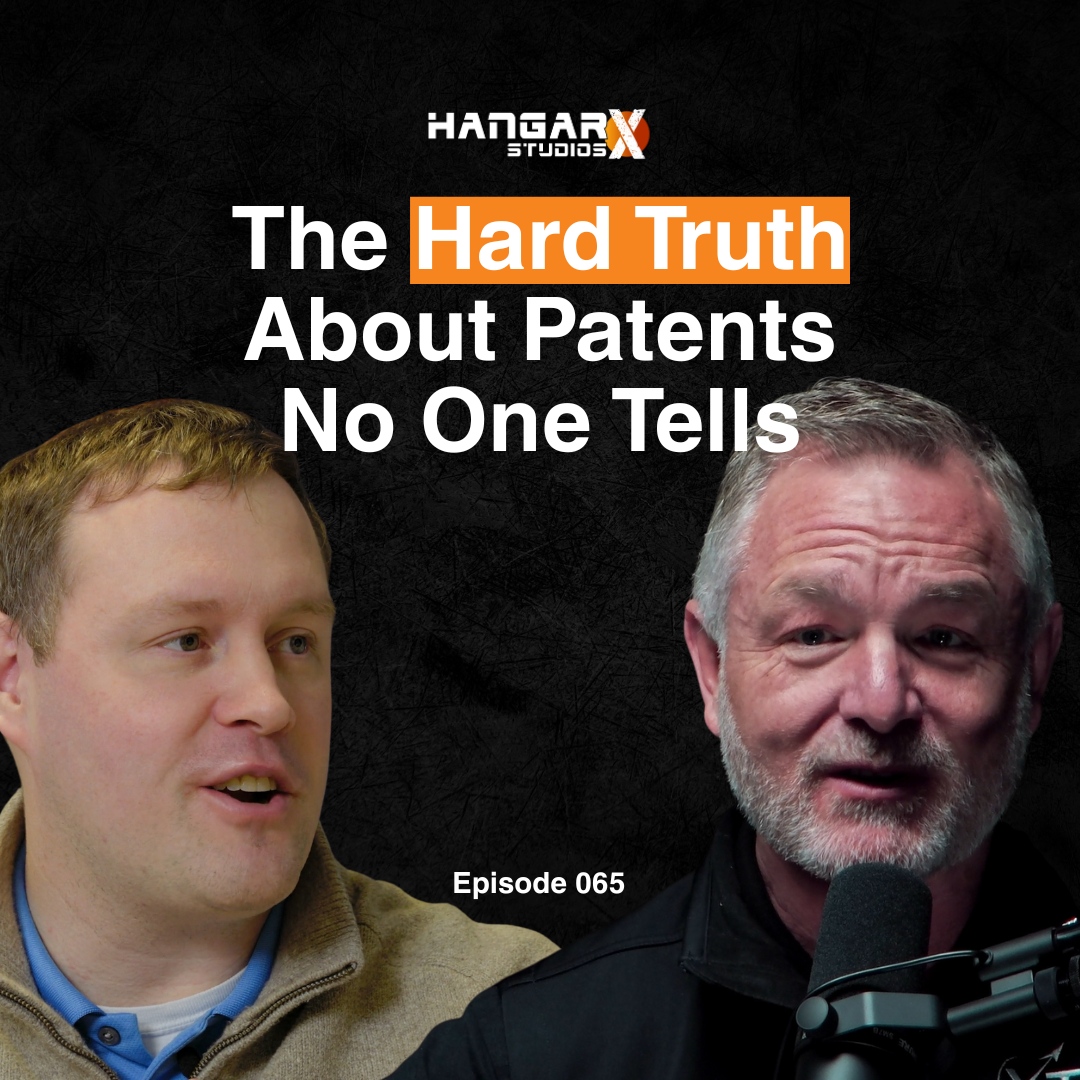
[00:00:00] Tom Kading: You know, let's say you're an established business, you're growing, and you know our mission. We want a team with innovative businesses in their growth. Okay? And so we go in and we say, hey, you know what, what's your IP look like? What's your unique marketable value proposition? And how do we protect that?
Welcome to Hangar X Studios, where former fighter pilot and host John Ramstead takes us on a journey across aerospace as it enters an historic period of innovation and transformation.
Our guests include aviation experts, pilots, financiers, military leaders, and innovators of all types.
Buckle up for another episode of Hangar X.
[00:00:48] John Ramstead: Today's episode is brought to you by our platinum sponsor, XTI Aerospace. They are powering the the vertical economy, building a long range VTOL. And you can find
[email protected] now please remember to, like, comment and share on this channel and enjoy today's podcast.
Hey, welcome to Hangar Axe. And we're live at the Hive in Grand Forks, North Dakota. And what we're going to be talking about today is, you know, as an aerospace company, whether you're drone, through vtol, through Powered Lift, it is essential and critical to have a strategy for your intellectual property, for your patents, for what that does for you as a company. So we wanted to bring on Tom Kading today. So, Tom, welcome to the podcast.
[00:01:33] Tom Kading: Absolutely. Thanks for having me.
[00:01:35] John Ramstead: Yes. And you're with Fargo Patent Law. You have offices up here in Grand Forks. You come up to the Hive, where we're at monthly to meet with all the dozens and dozens of companies that are here. You have some offices in Colorado Springs. But tell us a little bit of background on why you, you and your partners chose to focus on this part of the law and what you guys do.
[00:01:57] Tom Kading: Well, I think at the core of things, I'm an entrepreneur. I like to see opportunity. During law school, I got into various businesses and I exited. And then I started Fargo Patent Law. And, you know, I have an engineering background. And one of the prerequisites to be a patent attorney, you have to have a hard science background, and that was engineering. In this case, okay. I launched Fargo Patent Law. And you know, one of the spaces that's innovating, that's growing, that's exploding, both in North Dakota, all over the country, is the UAS aerospace area. And I think it's a lot of fun, too.
[00:02:31] John Ramstead: Yeah.
[00:02:31] Tom Kading: So that's in a nutshell. That's why.
[00:02:34] John Ramstead: Yeah. Now we were talking about, you know, my intellectual property, my patent strategy that a company should have, whether they're like early stage, pre revenue or even more mature. Could you talk a little bit about what are you seeing with your clients that are some good strategies or things maybe they forgot about and like, oops, that was a mistake. We can learn from that with the next client we're working with.
[00:02:56] Tom Kading: So one of the things I tell my clients, you know, patents, trademarks, it's a piece of paper until you do something with it. So you have to figure out how does the piece of IP fit into the overall business strategy. So ip, it's not just patents, it's not just filing a couple papers, it's how does that overall strategy all fit together. So when we go into a company, whether it's an early stage or established, and we love working with both, but you know, let's say you're an established business, you're growing, and you know our mission. We want a team with innovative businesses in their growth.
[00:03:30] John Ramstead: Okay.
[00:03:31] Tom Kading: And so we go in and we say, hey, you know, what, what's your IP look like? What's your unique marketable value proposition and how do we protect that? So we look.
[00:03:41] John Ramstead: Know what that is or do you have them look through this and say, hey, this is patentable, this should be protected. Is it, is that what you mean when you're, you're partnering with them?
[00:03:49] Tom Kading: It's, you know, I would say a lot of them, Some of them do. A lot of them don't. And, but don't know. Yep. And, and especially don't know how to do it. So they might be like, hey, we sell this X widget and this thing's awesome and this works great, but how do we, how do we protect that? And they might be like, hey, I want to patent this whole thing. But it's. Well, you can't really patent that whole thing. We need a, we need to keep this piece with a trade secret. We need to have a patent here and we need to keep your brand strong and then have a contract map to kind of lay out, hey, what is your relationship to the industry and how are you protecting that? Yeah, so that's what they really don't know. And that's kind of that big picture.
How do you do it?
[00:04:29] John Ramstead: Yeah, well, I know we've all watched Shark Tank. Right. And they always love to ask, you know, do you have a patent? Oh, we've applied. I have a utility. Can you talk about what are some of the patents, you know, on products, process, the different levels. Just so, just to educate people on what this is.
[00:04:44] Tom Kading: Yeah, so, so patent, you say Hey, I want to, I want a monopoly. I want exclusive exclusivity on a certain concept that I came up with.
[00:04:53] John Ramstead: Yeah.
[00:04:54] Tom Kading: So utility patent, hey, I'm going to patent something useful. I'm going to get a 20 year more or less monopoly on the concept. But that 20 year, right, and you file it, you file it with the U.S. patent Office and you disclose kind of what the concept is.
And assuming it's novel and non obvious, turns into a patent and you get that 20 year. Right. So the utility patent, that's on something useful, the design patent's like, hey, I've got a unique look, I've got a unique shape to my drone. Unique shape to my, whatever it might be. I want to patent that shape or that ornamental appearance. And that would be a design application. Design applications are usually a little bit easier to get through. It's a shorter monopoly, a 15 year monopoly. Okay. So those are kind of the two different types of patents you can pursue.
[00:05:44] John Ramstead: So design and utility.
[00:05:45] Tom Kading: Yeah.
[00:05:46] John Ramstead: Okay.
[00:05:46] Tom Kading: Then there's trade secret too. So some people are like, hey, you know, I have something that's a secret, like algorithm or some sort of software or something like that.
[00:05:56] John Ramstead: Would a process be part of that too?
[00:05:58] Tom Kading: It could be.
[00:05:59] John Ramstead: Okay.
[00:05:59] Tom Kading: Process could really fit into either the trade secret side or the patent side, Utility side. Yeah. Okay. And oftentimes what we say is, hey, you know, if you can keep something a secret, maybe keep it a secret, but if something's in the public, you know, people very well could rip you off. And that's where patent might be.
[00:06:17] John Ramstead: Or go use your idea to go make money.
[00:06:18] Tom Kading: Exactly.
[00:06:19] John Ramstead: So that leads me to another question is how do I, what, How do I think about almost this, my IP and an IP strategy to use that as a, either foundational or an asset to my company?
[00:06:32] Tom Kading: Yeah. So that's a great question.
People look at patents or IP and they're like, hey, I'm going to sue my competitor, I'm going to sue someone over this. But that's really not what my opinion is. It's, you know, it's expensive and takes.
[00:06:46] John Ramstead: A lot of time.
[00:06:49] Tom Kading: It's very expensive.
[00:06:49] John Ramstead: Yeah. So help me rethink what the, what most people view of a patent is. Right.
[00:06:54] Tom Kading: So yeah. So I say, hey, you know, set this thing up so that maybe you want to raise capital for an investor. Maybe you want to sell in three to five years.
Maybe you just want to put friction in the marketplace so that, you know, your competitors think twice about jumping in and they're like, hey, you know, I see you have a patent. We could go that route, but we're going to go another route because we know there might be an issue there. So we're going to avoid it. You know, 99% of contracts aren't litigated, 99% of patents aren't litigated. So if you can use them without getting into the litigation, that's going to be a win.
[00:07:30] John Ramstead: So what, how would you define what an IP portfolio is?
[00:07:34] Tom Kading: So in my mind, a good IP portfolio, you're going to have your, you know, your patent technology, you're going to have your secret technology, your trade secrets. Okay. You're going to have your contract map. How does your technology interface with other parties, outside parties.
And then you might have some open source stuff like how do you get integration into your platform? Maybe you don't want to keep certain parts of it secret so that other people can, you know, work with you.
[00:08:02] John Ramstead: So this could be software, hardware. Like, what are some of the things that are patentable? Like, especially when you're, you've been looking in the aerospace.
[00:08:09] Tom Kading: Yeah, software is a little bit tricky.
[00:08:12] John Ramstead: Yep.
[00:08:13] Tom Kading: Hardware, absolutely. Hardware. If you come out with a unique use for a sensor or unique shape or unique, unique component to something, you're like, hey, this unique novel component is marketable and everyone in the industry wants it. That's what you want to look at. Patenting. So hardware, Absolutely. Software, you know, patenting algorithms, patenting abstract ideas, certain software concepts. It gets very difficult, could be a.
[00:08:41] John Ramstead: Little more challenging, but worth exploring.
[00:08:43] Tom Kading: Yeah.
[00:08:43] John Ramstead: But you can also give some feedback on that.
[00:08:45] Tom Kading: Yeah. And that's all part of it, you know, figuring out how do you build the moat around your concept, how do you, how do you, you protect that. And sometimes it's not always protect the main idea because maybe that's not patentable. Maybe you protect the things around the main idea so that, you know, you keep them from getting after that main idea.
[00:09:03] John Ramstead: Little strategy there.
[00:09:04] Tom Kading: Yep.
[00:09:06] John Ramstead: All right, so what's your website at?
[00:09:08] Tom Kading: So we're FargoPatentLaw.com.
[00:09:10] John Ramstead: Yep. So up here in Grand Forks, Fargo, here at the Hive, Colorado Springs. So you know anybody out there that's thinking about this? You're building something. You're, you're, it's worth having a conversation.
We were actually talking before this. So we're actually going to be sitting down with you and just reviewing kind of our plans, our thoughts. There's some areas that we can strengthen or focus on or even get your feedback. Hey, you should pursue this, not pursue this, because it's going to help you both with raising capital, building your aircraft competition. There's a lot of things to consider.
[00:09:42] Tom Kading: Absolutely fair. Absolutely.
[00:09:44] John Ramstead: All right. Thanks, Tom. Appreciate it, man. Good to have you.
[00:09:46] Tom Kading: Absolutely it.