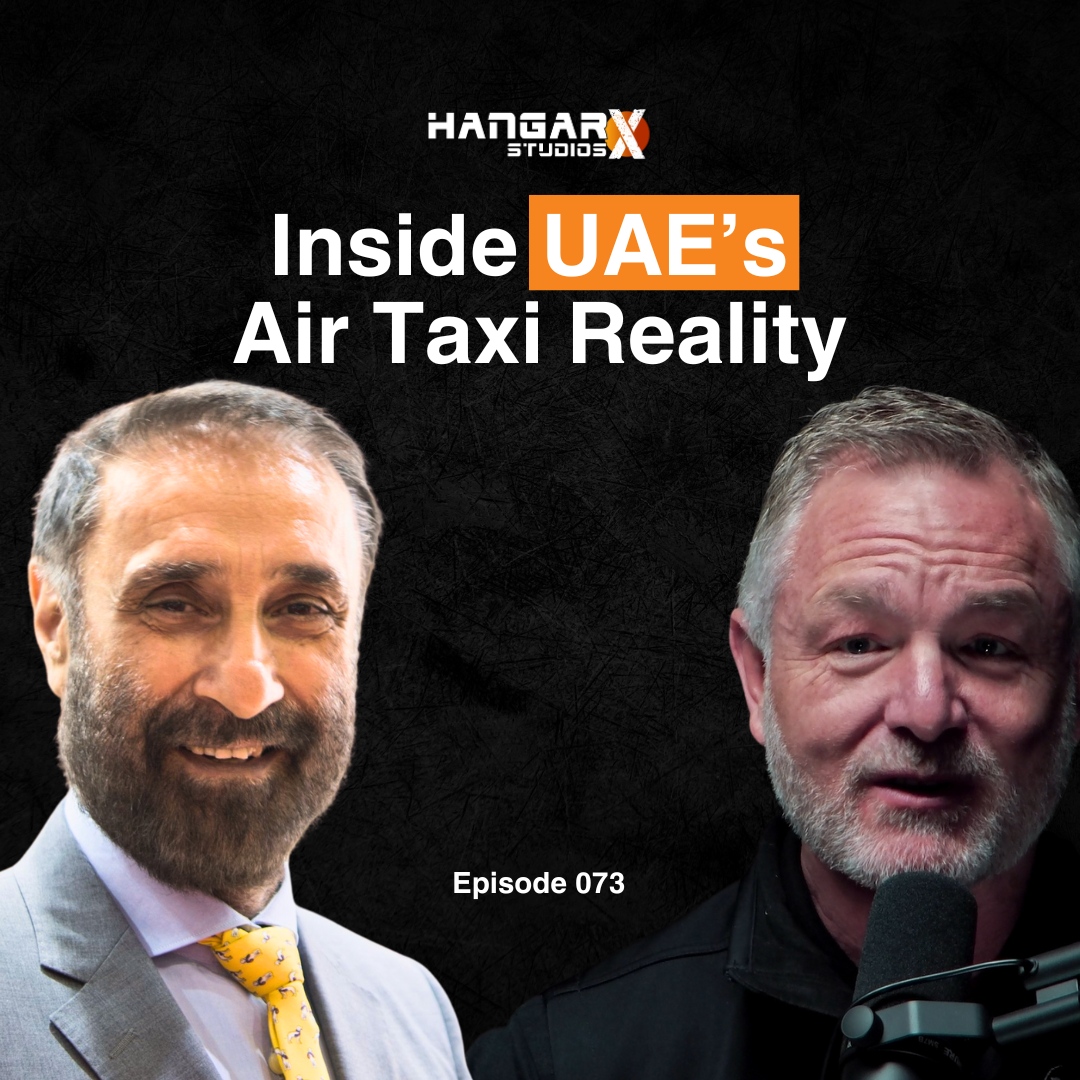
[00:00:00] Speaker A: You're competing with a very good road infrastructure. The highways are amazing. So to make air taxis work, it's not going to be easy because you're competing with a very good road network. So we are thinking out of the box and saying, well, besides being air taxis, how else can we use EVtols?
[00:00:23] Speaker B: Welcome to Hangar X Studios where former fighter pilot and host John Ramstead takes us on a journey across aerospace as it enters an historic, historic period of innovation and transformation.
Our guests include aviation experts, pilots, financiers, military leaders and innovators of all types.
Buckle up for another episode of Hangar X.
Today's episode is brought to you by our platinum sponsor, XTI Aerospace. They are powering the vertical economy, building a long range VTOL and you can find
[email protected] now please remember to like, comment and share on this channel and enjoy today's podcast.
Welcome to the HangerX Podcast and thank you everybody for being part of this. We are growing and growing and growing. We have millions and millions of downloads and views and that's because of you and our audience. And please, when you as you're watching this, hit subscribe so you can get notified of the incredible content.
Access to visionaries, talking to leaders and CEOs that are shaping the changes in not only aerospace, but air mobility and vertical lift and powered lift. And just some incredible things coming on today. And we have all heard about the incredible activity that's happening in the Middle east, especially in Dubai in the Emirates. Joby's coming over there, Archer's coming over there. And it's a place that's really leading the charge of transforming the world.
And so we really wanted a firsthand view of that today. So today we have on Captain Ramon Oberoi, who is the Chief Executive Officer and Accountability Manager at Falcon Aviation Services. So Rahman, welcome to the podcast.
[00:02:14] Speaker A: Thank you, Hangar X. I'm very happy to be here and discussing with you the future of aviation and especially in Middle East.
[00:02:23] Speaker B: Yes, it's good to have you. Now I have a bio and it's too long for me to memorize, so everybody, I'm going to read a bio here. Indian Air Force helicopter pilot, instructor examiner, test pilot. You were trained at the French Test Pilot School. You've flown VVIP missions for the Abu Dhabi Royal Family.
You held leadership positions COO before assuming the role of CEO at Falcon.
Four decades of experience across military, business, commercial aviation.
And what I love is you have this mix of both operational and executive vision that you've brought into Falcon, especially With all the changes that are happening right now. And now under your leadership, Roman Falcon has expanded both fixed wing and helicopter operations across the entire Middle East. And you've pioneered advanced air mobility initiatives which we're excited to talk about today. You've forged partnerships with big evtol companies, Archer, Eve Autoflight, there might be some others.
And recently you partnered with the UAE to create the first hybrid heliport design. And that's going to be in Abu Dhabi. And your whole focus and what we're talking about is connecting what you're doing at Falcon.
Your aviation experience, advanced mobility to position the company and the Gulf region to be leaders in next gen air transport. Right. And so you're setting the pace that a lot of the world is watching and learning from. But also some, you know, people are also trying to compete and keep up and you know, they want to be first too. So you know, that kind of starts with this. You know, there's, there's been a lot of talk about EVTOLs, there's been some stories about some big wins, some big failures. And to build the real momentum, you need operators, you need infrastructure to be able to bring, I think, you know, or bridge today through this kind of vision for tomorrow. So with your decades of experience in both rotorcraft and fixed wing and leading this, what do you think gives the Gulf region maybe an advantage to bring in advanced air mobility first?
[00:04:30] Speaker A: So first of all, the UAE has taken the lead. They want to be first in a lot of things.
They have the momentum, they have the finances to do it and the leadership is very smart. Dubai is one of the smartest cities in the world and they're creating a lot of amazing things, you know, they want. And Abu Dhabi is just another extension of Dubai, is doing a lot of things on its own way and, and there's Russell Kemah which is getting win as a casino. So there, there a lot of momentum here where UAE wants to be almost first in the world to do a lot of things, you know. So we are very lucky to be in this space here, especially as a Falcon innovation with the backing of the, the government and the ruling family. So this is a very good opportunity and we have taken this to prove to the world that we can do. And so it's all started.
So to answer your question, this is a government based initiative which is that their willingness to, you know, be first in the world first. Recently with the President Trump's visit, they announced the AI city to be made in Abu Dhabi. So there are many initiatives they're Taking to take the lead in lot of things, you know, so UAM is. Urban air mobility is one of the initiatives among many.
[00:05:58] Speaker B: Okay, yeah. And if I think about the geography of the region, I've been there many times and I also think about the regulatory environment. Are there some things that are also unique that maybe the rest of the world can learn of about what they've done from maybe a policy perspective that's allowing what's happening in Dubai to roll out the way it is?
[00:06:22] Speaker A: Yeah. So we work with the regulator very closely. We have been doing a lot of projects in earlier bringing in new types of aircraft, but this is a unique thing. We didn't have the regulation. So recently they have, you know, with the Archer, they said, okay, maybe they want to be a state of design for some EVTOLs. But also they've taken initiatives with, you know, FAA and EASA and also with Chinese regulators now with the signing a bilateral agreement which they're going to do very soon. And that any of these three regulators, if they cert they will respect that type certification and allow us to use that in uae. So that's the direction they're going.
[00:07:09] Speaker B: Now. Falcon. And you maybe you can give us a little background on Falcon. But you know, large operator, both fixed wing and helicopters and you know, you're really positioning yourself to be one of the major players in this, you know, future air mobility. Mobility.
And you know, Raman, I think it's interesting, you know, here, take a traditional aviation company, helicopters and fixed wings. Now you're bringing in an entire new aircraft.
Right. With, you know, the servicing, the scheduling, the maintenance, the infrastructure.
What are some of the things that, you know, the core competencies of Falcon and how do you transition those or modify those so that you can bring in, you know, these, these EV tolls and operate them effectively. It's almost like operating, you know, opening up a whole new business unit. Or is it, or is it not like that?
[00:07:59] Speaker A: We don't feel like that. In fact, we just see as an extension of our business. We already operate six types of fixed wing jets and turboprops and we are flying seven types of helicopters of various sizes.
So this is just extension of our business.
We already operate lot of heliports all over uae, which actually we, we manage and operate. So using the same infrastructure to be a hybrid vertiport is just an easy fix. We're not creating anything different. We already are a MRO for so many types of aircraft. So this is just an extension for me.
In fact, some of the types which you're trying to induct as we tall ones is in fact easier as a MRO because these are easy designs and the electric elevation brings in possibilities of less, you know, inputs of maintenance.
And I think this will be easier fix for us.
Yes, for the operation and pilot training. That's a separate subject we are coming into. But as a company we. We don't see as a big is a challenge which is interesting, but we are not overwhelmed by. It is good to learn as the world is growing with it and to be the first.
But personally I've done a lot of these things as a test part and other things. So we are used to progressive integration of technology and also do risk assessment at every stage.
So I don't think it's a good opportunity. We are happy to be here. I mean, I don't see as a very, very big challenge.
We can handle it easily.
[00:09:52] Speaker B: Okay. Yeah. And question for you. I think of the Gulf region vertical lift helicopters for tourism, oil and gas. VIP transport is very mature.
Like some other places in the world. Sao Paulo, right. So many helicopters and heliports bringing in the EVTOLs. From your perspective, what problem does it solve or enhance when you already have a mature helicopter infrastructure?
[00:10:18] Speaker A: So personally, this is my perspective running the business for so many years, 15 years in Abu Dhabi and Dubai. We do 1,000, sorry, 75,000 passengers every year from Atlantis, the Palm for tourism.
And we carry 1,000 passengers every day for oil and gas during with the turboprop. So helicopter fixing. We are used to these volumes. But connecting cities at the moment is we. We have a lot of VIP helicopters only very big sheikhs and some top class companies use use the helicopter as a transport because it's too expensive.
So basically and number two, you're competing with a very good road infrastructure. The highways are amazing. So to make air taxis work, it's not going to be easy because you're competing with a very good road network. So we are thinking out of the box and saying, well, besides being air taxis, how else can we use EVTOLs? So our focus is elsewhere.
Air taxi is a name of evtol. But our focus will be many fold in many other ways.
For example, oil and gas logistics support.
We want to use carry all from auto flight to do cargo transports of oil and gas.
[00:11:51] Speaker B: Does that tend to be autonomous that mission? If you can?
[00:11:55] Speaker A: Yeah, it's a control from the ground.
So we'll start progressively with that. So we like to have logistics support initially, learn from it and then grow into passenger transport as A second step.
So. So we will continue learning these machines with the hours built on this. And then the passenger transport surely will be with pilot because the world is not ready for autonomous EVTOLs with passengers. But the cargo one is already certified with auto flight and we want to induct it in the coming months, not years, coming months to start cargo operations.
[00:12:42] Speaker B: Question for you. Like you think of advanced air mobility, these are electrified airplanes. I think their effective range is, you know, 40 to 60 miles. And then they got to be. They have to be recharged.
[00:12:52] Speaker A: Yes.
[00:12:52] Speaker B: And there's another group though, some of these more regional VTOLs, right? They're maybe a little more conventional, they fly faster up to 300 knots, you know, let's say a 50 to 300 mile mission, you know, and there's a number of companies in that space, so there's almost like these segments, you know, if that was, if that was out and you had that kind of capability, where would that fit into your mix of how you're serving your customers?
[00:13:18] Speaker A: I feel that the battery densities are reaching almost a big hurdle to increase the range. And some of these companies and models have been very heavy because of that. So they're reaching the 70 mile. But the auto flight cargo version has got 250 kilometer range, which is higher than many others. But now all of them are saying that this can only be solved by having a hybrid version.
And so most of these guys are slowly going to hybrid ones and that's where the success will lie. Yes, having a small engine on board which continues to charge the battery weighs the solution. And Most of these EVTOLs are going in that direction. But I think for as helicopter, I mean some of the companies we're working with, maybe one of them is Auto flight are able to give me 1000 kilometer range with hybrid version within one year's time. So that lies the solution of the range. But surely 60, 70 miles for the purpose we are looking at. That's the logic support and oil and gas support is too less. Yes, connecting, even connecting cities is too less.
But within the city transport, yes, it is fine.
But for me that business is very, very small because for me, so the range must be there to have a flexibility for using. Right. From 20 miles to up to say 300 miles, you know.
[00:14:58] Speaker B: And Salim just texted me, he had a question as he was listening in here. He said, could you clarify, will the UAE type certify these EV tolls before the country of manufacturer?
Do you know?
[00:15:14] Speaker A: So I don't know. UAE is one of the company is Lord Aviation. They are making their state the aircraft designed within uae but they. They'll be certified by GCA as a state of design. Archer, I. I'm not sure Archer initially had a plan of certifying in uae. I'm not sure where they stand but because they're continuing with the FAA certification but UAE is. GCA is happy to accept any other type certification either from USA or on EASA or China and they will let us operate that under that type certification.
[00:15:58] Speaker B: Okay.
[00:15:58] Speaker A: Yeah.
[00:16:00] Speaker B: Interesting. Thank you. Now I'd like you to talk about.
You've had a lot of talk about vertiports and the hybrid vertiport and building landing charging.
And if it's hybrid we might need jet fuel.
We need charging.
We've done a lot of research. It's expensive, there's a lot of weight involved. There's a lot of time and planning. But Falcon has partnered with Archer and with the government there in Dubai. Could you talk a little bit about this partnership? What's evolving and what is happening right now from an infrastructure standpoint.
[00:16:38] Speaker A: Some of these vertiports are owned by hotels or sometimes Abu Dhabi port owns that vertiport in Abu Dhabi.
They are also creating some vertiports under Abu Dhabi airport authority which is taking care of some more. They're going to make 14 vertiports. But two vertiports which we are operating in Dubai, one that is the Palm and Abu Dhabi port here we have gone through the hybrid vertiport.
We are opening this business to many operators. Will not be monopoly and we'll try to get as many operators. There'll be landing charges which which is supported by the government will have to be reasonably priced. There'll be two or three types of mobile charging. So the we Beta is supplying some of the charges the Chinese Auto flight has got which is backed by Catl as a battery company, our owner of the autoflight. They're giving now liquid charging charges which help us to charge fast. And I think Beta is going to do the same. Beta is doing the same. So the charging time reduces to 15 to 20 minutes, you know, because the cooling, liquid cooling of the batteries while they're being charged. So that charging times have been reduced drastically with this new mechanism. And therefore they are also mobile charges. They are not very huge in nature. So we don't want to in the vertiport we have to be careful that these aircrafts when they land in their position in the landing pads that they don't. There should be enough capability either the charger to reach There or the charging mechanism should be long enough to reach there. Okay. And without having any obstruction to the operation. So, so most probably we, we are trying to get the mobile charger.
[00:18:38] Speaker B: So when you say mobile charger I'm almost thinking in my head like this is a ground, like ground support equipment. I drive it up next to the evtol, I plug it in, I start it up. There's it has its own generator.
[00:18:51] Speaker A: That's true.
[00:18:51] Speaker B: We're using liquid cooling. I so that way I don't have to have all this heavy infrastructure.
Like I'm thinking of a Tesla charging station. Right, you're not. No, no. You're actually going to drive over and charge as needed. That way it's much more efficient. That's what I hadn't thought of that before but that makes actually a lot of sense.
[00:19:10] Speaker A: Yeah, yeah. I mean sometimes evital gets stuck in the le pad we can drive down that charger to that vertiport and say okay, here we charge. Or if a diversion landing due to any reason. So that flexibility we learned in the helicopter operations a lot. You know, where the fuel was not available, we could drive down with the fuel anywhere. So this. Okay, now what is evtol? Fuel is batteries. The battery is your fuel. So now we should have capability to drive down the fuel or that's in case battery anywhere where it's needed. You know, so that's what we, we like to do. Yeah.
[00:19:45] Speaker B: You know, from a technical or regulatory perspective, what challenges do you have? The first one that comes to mind is fire suppression. These big lithium ion batteries they have, they burn. If it did kick off, they burn for a very long time. How are you thinking through that?
[00:20:00] Speaker A: Yeah. So there have been regulations in this.
The UAE has issued that we have to follow those. The firefighting equipment has to be fully available with those regulations to be met. And that one challenge we have to meet and have a very good fire suppression firefighting system for this kind of fires which is different than. So yes, if it's a hybrid heliport then they should have two firefighting mechanism, one for the battery fire and one for the fuel fire. So both should be met.
[00:20:35] Speaker B: Is there any other technical. If you guys have been working through this, any other, you know, big problems you've had to solve?
[00:20:42] Speaker A: Initial thoughts we have regulations in place, we are slowly working but I'm not saying we are continuing to work with many weekly meetings and with regulator within ourselves and every time we come across new hurdle, we'll cross it that time. Okay.
[00:21:00] Speaker B: Yeah. Now question operating in that environment.
Right. You know, I've flown over there in the Middle east quite a bit. It can be hard on the airplanes. The sand, the dust, the, the heat. You know, you're flying, you're going to be at probably maxed out weight because you want to fill the seats.
What have you been seeing as far as the resilience, the maintainability, the dispatchability of this type of aircraft relative to a helicopter or a turboprop?
[00:21:32] Speaker A: So my worry is that none of this.
And you know, companies who are not being aviation companies, I mean there have been yes in certain ways, but they're not operated helicopters and that way. And these are big challenges today. I can tell you the helicopter like 109 VIP helicopter.
Every 1000 hours I have to change the engine for, extend it for overall the hot section.
This is totally one third the value I get in Europe or say in US and this we know that. So anybody who is claiming that the, you know, the operating cost of the, of the maintenance cost will be this and this are only guessing and I'll say we will. I'll multiply with three times to, to that figure to make it viable.
Okay.
[00:22:27] Speaker B: Okay. So all of these manufacturers, they tell you their numbers and you're like yeah, yeah, yeah, 3x and then you're gonna see if the numbers pencil out from there.
[00:22:35] Speaker A: Absolutely.
[00:22:36] Speaker B: Because nobody knows for sure, do they?
[00:22:39] Speaker A: Yeah, we don't run from helicopters. I'm assuming it's better to have your risk covered and if it does better, it's good for everyone.
[00:22:47] Speaker B: That's true. Well, you know, helicopters are a high bar. You know, they're expensive to operate.
[00:22:52] Speaker A: Yes, yes, yes. I mean next thing. Absolutely. I'm saying that each engine is the bigger helicopter is 2 to 3 million dollars. You know, engine here these EVTOLs which can, I mean this one thing I'm saying, okay, for example, some of these EVTOLs are 3 tons already.
They carry just 4 passengers and they have 12 rotor systems or 13 whatever.
So EC130, which is single engine helicopter has got powerful Safran engine, can carry seven passengers and it weighs only 2.5 tons and carries two hours of fuel with that.
So you know, you're competing with the set industry. You have to reach that bar.
So it's a dream to reach there at the moment.
So it's not easy going to be easy. This story, what you have been heard is long way to go to reach those standards which the we like to have.
[00:23:54] Speaker B: Well, you know, and there's a class that we're calling XVTOL Extended Range VTOL. They're conventionally powered VTOL, you know, take off. They're pressurized 6, 700. Practical range, 25,000ft, 300 knots.
[00:24:08] Speaker A: Yeah, I know.
[00:24:10] Speaker B: So if that was when those. And there's a number of companies, XTI is being one of them. They're our sponsor for our podcast. But there's four or five people in that space. It's not very crowded yet.
If that was now in service, how would that fit into what you're trying to accomplish in Dubai and the Middle East?
[00:24:28] Speaker A: So that's a total different business segment.
And we were approached by Leonardo for their tilt wing 609. But, you know, see, they're trying to sell me that at $25 million.
I mean, what advantage do I have? So the cost is main issue. And secondly, in this part of the world, the business class or business people want a space, you know, they want you. You can't even stand straight in this aircraft of 609, you know, so can you give the comfort? So only advantage is that, yeah, you can take off from a restricted area like a palace or somewhere, go to another place directly without.
But the cost and the market is very limited. You can say, okay, it can use for meduvac and all.
So I don't know that market. I've not studied it that much. How much of that will give advantage? Because in the end, the customer is also looking at the costs, you know, of doing that.
[00:25:32] Speaker B: Right.
Okay, that'd be good. Well, we'd love to follow, you know, as that area matures and we, I think, get a better understanding of the costs.
Yes, you'll probably 3x them anyway, and then we can figure out. And then we'd love to know because we're actually as long you go to.
[00:25:47] Speaker A: 25,000Ft and you're away from this dust atmosphere, maybe you'll have better advantage. You know, that's true.
[00:25:54] Speaker B: But you got to have a lot of power to take off vertically.
There's gonna be a lot of rounds, so.
[00:25:59] Speaker A: I know, I know, I know.
[00:26:01] Speaker B: So let me ask you this. So, you know, as you're thinking, you know, you're bringing in the EVTOLs, you're bringing in the vert, the.
The vertiports, the infrastructure.
Sounds like you're great partners with the country.
The partners, private industry.
What does this look like in. What are you thinking now? Two to three years? Where do you see this actually now?
Regularly serving the people. You said you're doing what, 75,000 tourists a year, a thousand a day? For oil and gas, does this replace and create a better product for them or does this expand the work? You know what Falcon is doing.
[00:26:46] Speaker A: So beside that, as I started, you know, I like to England with the ADNOC group, I would like to also compete with the surface or the sea transport of boats. You know, if I can show them that I can do cargo at three times or four times speed of the boards, maybe five times the speed and also be much more cost effective.
That market is there for passengers. I like to.
There are casinos coming, there are hotels coming. We have. I'm going into further direction. I'm working with a company which has got floating vertiports, you know, and that is a big advantage because 80% of population of UAE lives along the coast. But most important and the expensive part of the land is the coastline, you know, where they like have beautiful properties. So if we can make within $1 million of floating vertiport which can be moved from one hotel to another hotel as required or something like that, that's another option we're looking at. So these vertiports are certified. They have solar panel to give electricity. They could be moved from one place to another. So that's another direction we can look into.
[00:28:15] Speaker B: Love that. So if we put all this together, maybe ask this as kind of we wrap up. When you're looking at all these different companies, there's a lot of companies in this space and some of them, their technology readiness is getting more mature. They're moving towards certification.
What are some of the key criteria that you and Falcon look at when you're evaluating whether this could be a good fit for us or. Nope, that's off the list.
[00:28:40] Speaker A: Let me summarize the EVTOL Journey Tilam run. There are two types. One is lift and cruise, like Beta, Auto Flight, Beta's Alia and Auto flight's prosperity. And there is a tilt rotor which is Joby and Archer.
Aerodynamically I feel that lift and cruise have advantage. This is my assessment. Okay.
And second is so aerodynamically you have to be sound like I already said that if you are 3 ton, 8, 3.2 ton, just carrying four passengers, you already gravity is against you, you're too heavy. Next is the cost.
Now if you're telling me that I should buy this EVTOL at 4 to 5 million dollars, you already put me at a big disadvantage because you want me to compete with the taxis.
And if Tesla can give me $100,000, a good car or similar beautiful cars at $100,000, why would I buy something at $5,000,000 and compete with the surface transport. It just put me out of that thing and I have to create vertiports. What advantage will I give to any passenger who can reach from Abu Dhabi to Dubai in one and a half, two hours and say, okay, I can do it in 30 minutes. Yes, but at what cost?
So the acquisition costs should be reasonable and operating costs, as I have told you, they are just guessing, but it could be much higher than what their guess is. So cost is going to be a major factor to make this industry succeed.
[00:30:20] Speaker B: All right, so really what is it about lifting cruise versus tilt as we finish up here that appeals to Falcon?
[00:30:29] Speaker A: So lift and cruise is much simpler to control.
The flight control computers, let's say, have to have 100,000 parameters for a tilt rotor. They are 10 times more because the controllability is now much more complex.
Secondly, aerodynamically, the lift and cruise, the rotors just stop and they align with the fuselage and then the pushers come in and they, they, they are like a fixed wing then. So they are much more a aerodynamically sound and with less Dragon.
[00:31:10] Speaker B: Yeah.
I love how you're thinking about it and thank you for sharing that. And Raman, we'd love to have you back on at some time and maybe when we come up for the Dubai Air show or some other time, get to meet you in person out there.
[00:31:24] Speaker A: Sure, sure. Anytime, anytime.
[00:31:27] Speaker B: Yes. And everybody listening, thank you for being part of this. Please remember to subscribe, share this we have some incredible news coming out. You're going to want to be part of this. We're going to be launching a world class service that's going to give you insider aviation across aerospace that we believe is going to be a huge differentiator. So that's going to be coming out here in the next couple months. So stay tuned for that. So everybody, thank you, Raman, thank you again for your time and man, keep knocking them alive out there.
[00:31:55] Speaker A: Thank you, thank you, thank you Hangar X for having me in there.